New guppy keepers often run into the same frustrations: fish that lose their color, fins that stop growing, or babies that vanish overnight. Most of these problems come down to a handful of habits you can fix today. Here are eleven practical guppy care tips covering feeding, water, lighting, breeding, and disease prevention that will help your guppies grow stronger, breed more reliably, and show off brighter colors.
🐟 11 Guppy Care Secrets, Straight From Our Own Fish Room
Everything we do at Classic Guppy to raise stronger, more colorful, home-bred guppies in Pune.
Browse Our Guppies
Quick Takeaways
- Feed variety: rotate pellets, baby brine shrimp, and occasional bloodworms for stronger color.
- Keep lighting steady: aim for 8-10 hours a day with no sudden bright/dim swings.
- Prep your water: age well water or dechlorinate tap water before it touches the tank.
- Breed smart: use a trio (1 male : 2 females) and move gravid females to a breeding box early.
- Treat illness fast: a plain rock-salt bath can stop common problems before they spread.
- Watch stocking density: roughly one guppy per liter keeps stress and competition low.
- Hold steady at 26-27°C: temperature swings are one of the biggest triggers for disease.
Feed a Varied, High-Quality Diet
Guppies aren’t fussy eaters, but food quality shapes how strong and colorful they become. Rotate between fine pellets, baby brine shrimp, and occasional live or frozen bloodworms so your fish get a complete range of nutrients. Live plants such as hornwort also help: they give fry a place to hide, support beneficial bacteria, and keep water chemistry more stable. Most guppies do best in slightly alkaline water around pH 7.5, so if your source water tends to run soft or acidic, adding crushed coral to the filter or substrate can nudge the pH upward naturally.
- Rotate foods: fine pellets, baby brine shrimp, and occasional live or frozen bloodworms.
- Add live plants like hornwort for fry cover and more stable water chemistry.
- Target pH ~7.5 and use crushed coral if your source water runs soft or acidic.
Get the Lighting Schedule Right
Light does more for guppies than just letting you see them. A steady light cycle supports appetite, activity, breeding behavior, and color development. Too little light and fish become sluggish and prone to illness; too much and they can become just as stressed. Aim for a consistent 8 to 10 hours of light a day, whether it comes from a nearby window or a dedicated aquarium LED, and try to avoid sudden swings between very bright and very dim conditions.
Prepare Water Before It Touches the Tank
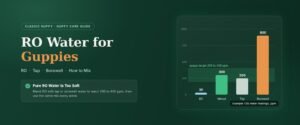
Water source matters as much as water quality. Well water is often chlorine-free and well liked by guppies, but it usually needs to sit for two to three days before use, since it tends to be noticeably colder than tank water and adding it straight away can shock your fish. Tap water is more convenient but contains chlorine, which needs to be removed through vigorous aeration, a few hours of direct sunlight, or a dechlorinator when time is short. Treat chemical dechlorinators as a backup option rather than a first choice, since letting water breathe naturally is generally gentler on your fish.
- Well water: let it sit 2-3 days before use since it runs colder than tank water.
- Tap water: remove chlorine via vigorous aeration, a few hours of sunlight, or a dechlorinator.
- Avoid shocks: never add fresh water straight from a cold source into a warm tank.
Set Up Breeding Pairs the Smart Way
Guppies are usually ready to breed at around a month old. To keep breeding consistent, maintain clean, stable water and a nutrient-rich diet, and consider housing fish as either a single pair or a trio of one male with two females to speed things along. If you’re trying to preserve specific colors or patterns, keep each strain in its own tank rather than mixing them. You can often tell a female is pregnant by shining a flashlight against her belly and checking for visible eye spots inside her abdomen; once you notice this, move her to a separate breeding box so the fry aren’t eaten right after birth. As fry grow, some will clearly be stronger and more vividly colored than others, and moving the slower, duller fry into a separate, well-planted tank gives them a better chance while keeping your main breeding line strong. A gentle air-driven sponge filter is usually a safer choice than a motorized filter for fry and adults alike, since strong currents can exhaust or even injure smaller fish.
- House as a trio: one male with two females keeps breeding consistent.
- Check for a gravid spot near the belly, then move her to a breeding box before she gives birth.
- Separate slower fry into their own well-planted tank so they get a fair chance to grow.
🌱 Ready to Start Your Own Guppy Tank?
Shop live-arrival-guaranteed, home-bred guppies shipped safely across India.
Shop Guppies Now
Recognize and Treat Common Guppy Ailments Early
Fungal patches, clamped tails, and unusual shaking are among the most common guppy health issues, and all of them are far easier to treat when caught early. A simple rock salt bath, never iodized table salt, at roughly a handful of salt per 15 to 20 liters of water is a widely used first response. During treatment, cut back feeding significantly, and only resume normal portions once the fish is visibly recovering. Fish from unknown or unverified sources deserve extra caution, since parasites like anchor worms can spread quickly through an entire tank system once introduced. Watching new arrivals closely and avoiding overcrowding go a long way toward preventing outbreaks in the first place.
Choose Tankmates Carefully
Guppies are peaceful, easygoing fish, which means they don’t mix well with aggressive tankmates such as large cichlids or predatory catfish. Better companions include neon tetras, mollies, swordtails, shrimp, and apple snails, all of which share a similar temperament and similar water needs.
Keep Feeding Costs Under Control
If guppies are your main focus, it’s often more economical and easier to manage a tank with guppies plus a few cleanup helpers like shrimp or apple snails, rather than a large mixed community. Combining guppies with many other species tends to raise food costs, complicate feeding routines, and lead to dirtier water since it becomes harder to judge how much each species is actually eating.
Watch Your Stocking Density for Better Growth
A simple rule of thumb many breeders use is roughly one guppy per liter of water, so a 30-liter tank comfortably supports about 30 fish. Staying close to this ratio reduces stress, keeps oxygen levels healthier, and cuts down on competition for food, all of which show up as better color, fin growth, and overall body condition.
Pick Breeding Stock With an Eye for Quality
Strong parents make strong offspring, so it pays to be selective. Favor guppies with a thick, well-proportioned body, active swimming, vivid and clearly defined color, and balanced, undamaged fins. For patterned strains, look closely at how clean and consistent the pattern is, since faded or muddled patterns tend to carry through to the next generation. Setting aside your best-looking, healthiest fish as breeders, rather than breeding from weaker or duller individuals, keeps overall quality improving over time, which is also why well-bred guppies often sell for more.
Understand What Shapes a Guppy’s Lifespan
Guppies typically live one to two years, with the actual lifespan depending heavily on water quality, diet, temperature, and how often they’re bred. Most guppies look their best between three and four months old, when color and fin development peak, and missing this window without adequate care can lead to faded color and deteriorating fins later on. Feeding also plays a bigger role than many beginners expect: overfeeding accelerates aging and digestive issues, while underfeeding leaves fish undersized with weak color and fin growth.
Treat Temperature as a Non-Negotiable
Water temperature has a direct effect on a guppy’s metabolism and overall health. Below about 24°C (75°F), guppies eat less, become more susceptible to illness, and water quality can decline faster. The generally recommended range is 26 to 27°C (78 to 80°F), which supports strong growth, good color, and better longevity. On the other end, temperatures above 30°C (86°F) can cause guppies to eat and grow quickly but age and develop fin rot much sooner, so any bright color gains tend to be short-lived. In colder climates, a reliable aquarium heater helps avoid the temperature swings that stress fish and open the door to disease.
- Ideal range: 26-27°C (78-80°F) for strong growth, color, and longevity.
- Below 24°C (75°F): appetite drops and disease risk rises.
- Use a reliable heater to avoid the swings that stress fish and invite illness.
Final Thoughts
None of these guppy care habits are complicated on their own, but together they make the difference between a tank that struggles and one that consistently produces healthy, vividly colored fish. Start with clean, properly prepared water and a stable temperature, build good feeding and lighting routines around that foundation, and be selective about which fish you breed from. The rest tends to follow naturally.