A guppy-focused breakdown of sand, gravel, aquasoil and bare-bottom setups, so you can pick the right substrate for your goals.
Does a Guppy Tank Need Substrate?
Guppies don’t dig or forage in the substrate the way corydoras or loaches do, so technically a bare-bottom tank works. Most keepers still add a substrate because it anchors live plants, gives beneficial bacteria more surface area, and makes the tank look far more natural.
Substrate also shapes how the tank reads visually. A dark substrate makes the reds, blues and metallics in a guppy tail stand out sharply, while a pale sand bed washes those colours out and can make fish look faded. If you keep fancy strains for their colour, that alone is a reason to think about the choice rather than grabbing whatever is on the shelf.
Sand
Fine sand gives the cleanest, most natural look and is gentle on the barbels and bellies of any bottom-dwelling tankmates. Waste sits visibly on top, which makes it easy to spot-clean with a turkey baster, but it can compact and trap gas pockets if it’s not stirred occasionally.
Keep sand to roughly two or three centimetres deep and stir it gently during water changes so anaerobic pockets never get a chance to form. Pool filter sand and inert aquarium sand are both good, inexpensive options. Avoid very fine play sand, which packs tightly and clouds the tank every time it is disturbed.
Gravel
Gravel is the easiest substrate for beginners: it’s cheap, widely available, and won’t compact the way sand can. Choose a rounded, fish-safe grain size rather than sharp aquarium gravel, and vacuum it regularly since waste and leftover food settle between the pieces.
Choose a grain size around two to five millimetres. Very coarse gravel lets uneaten food and waste fall deep where you cannot siphon it out, which is a common hidden cause of nitrate creep in guppy tanks. Rinse any new gravel thoroughly before it goes in, and avoid painted or coated decorative gravel, which can chip over time.
Aquasoil
Aquasoil is the top choice for a heavily planted guppy tank because it’s nutrient-rich and lets roots establish quickly. It’s more expensive and can cloud the water for the first few days, and it will eventually break down and need topping up, but the plant growth it supports is hard to match.
Be aware that most aquasoils actively soften water and lower pH, which is the opposite of what guppies prefer. In a heavily planted guppy tank that usually stays manageable, but if your water is already soft it is worth pairing aquasoil with a little crushed coral in the filter to hold KH up. Aquasoil also breaks down over one to two years and eventually needs replacing.
Bare Bottom
A bare-bottom tank is the easiest to keep spotless and is popular for breeding and grow-out tanks where hygiene matters more than looks. Waste is simply siphoned off the glass, though the tank will look starker and you’ll need root tabs or pots for any live plants.
The trade-off is appearance and biology. A bare tank looks clinical, offers no rooting space for plants, and gives beneficial bacteria less surface area, so you lean harder on your filter to carry the biological load. Many breeders run bare-bottom grow-out tanks alongside a planted display tank and get the best of both.
Mineral Substrates and Water Hardness
Guppies evolved in hard, alkaline water, and they do best somewhere around pH 7.0 to 8.0 with moderate to high general hardness. If your tap water is soft, a tank can drift acidic between water changes as waste breaks down, and those swings stress fish far more than a steady reading at either end of the range would. Mineral substrates fix that at the source instead of asking you to dose chemicals every week.
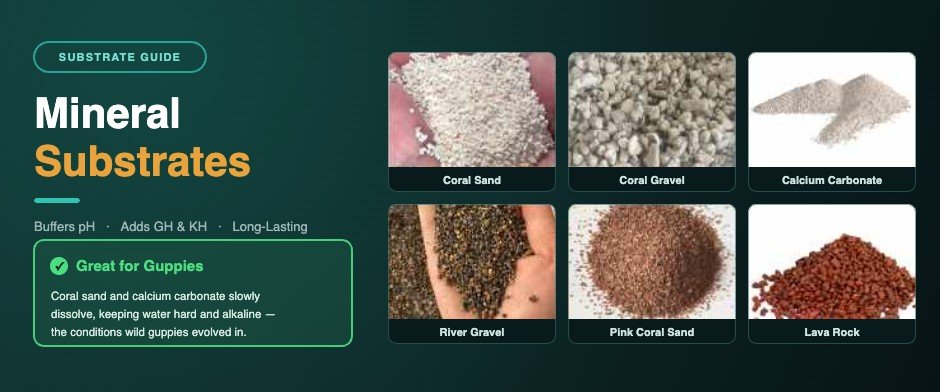
Coral sand, crushed coral gravel and calcium carbonate are all calcium-based and work the same way: they dissolve extremely slowly, releasing calcium and carbonate into the water. That raises general hardness (GH) and, more importantly, carbonate hardness (KH) — the buffer that stops pH from crashing. A thin layer worked into the substrate, or a mesh bag of it tucked into the filter, holds your parameters steady for months. For guppies the benefit goes past comfort: dissolved calcium supports fry development, healthy scales and the heavy finnage fancy strains are bred for.
The other materials in the picture do different jobs. River gravel is inert, so it changes nothing about your water chemistry — that makes it the right choice if your tap water is already hard and you only want a substrate for looks. Lava rock is porous and light, which makes it excellent biological media and a good anchor for plant roots, so it works well as a base layer underneath sand or aquasoil rather than on its own.
Add mineral substrate gradually. Filling a tank with coral-based material all at once can push hardness up faster than your fish adjust to, so start with a thin layer or a small filter bag, test GH, KH and pH weekly, and add more only if the numbers are still low. If your water already runs hard from the tap, skip the coral entirely and use inert sand or gravel.
Choosing by Goal
There is no single best substrate for every guppy tank. The right answer depends on whether you are prioritising looks, plant growth, fry survival or the least possible maintenance.
- Simple, low-cost community tank: gravel.
- Planted display tank: aquasoil, or sand with root tabs.
- Breeding or fry grow-out tank: bare bottom for easy cleaning.
- Natural-looking show tank: fine sand.
- Soft tap water: add coral sand, crushed coral or calcium carbonate to hold GH, KH and pH steady.
Frequently Asked Questions
Is sand or gravel better for guppies?
Both are safe. Sand looks more natural and is easier to spot-clean; gravel is more forgiving for beginners since it doesn’t compact.
Do guppies need substrate to breed?
No. Many breeders use bare-bottom tanks specifically because they’re easier to keep clean for fry.
How deep should guppy tank substrate be?
About 1 to 2 inches is enough for a non-planted tank; heavily rooted plants may do better with 2 to 3 inches of aquasoil.
Does coral sand raise pH too much for guppies?
It raises pH toward the 7.5 to 8.0 range and then largely self-limits, which is where guppies are most comfortable. Add it gradually and test, rather than filling the tank with it at once.
Can I mix two substrates in one guppy tank?
Yes, and layering is common. A porous base such as lava rock under sand or aquasoil gives roots something to grip while the top layer sets the look you want.