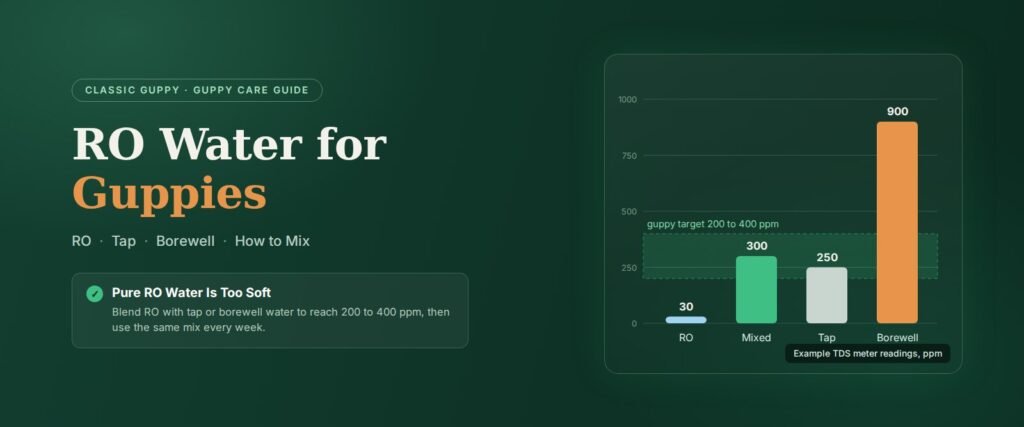

Most Indian homes now have an RO purifier in the kitchen, and a cheap TDS meter is easy to buy online. That leads to a very common question from new guppy keepers: should I use RO water for guppies, because it is cleaner? The short answer is not on its own. Pure RO water is too empty for guppies, and borewell water is often too heavy. The right water for most tanks in India is somewhere between the two, and a TDS meter is the simplest way to find it.
The Short Answer
- Pure RO water is too soft. It has had almost all minerals removed, and guppies need minerals for healthy bones, fins and fry growth.
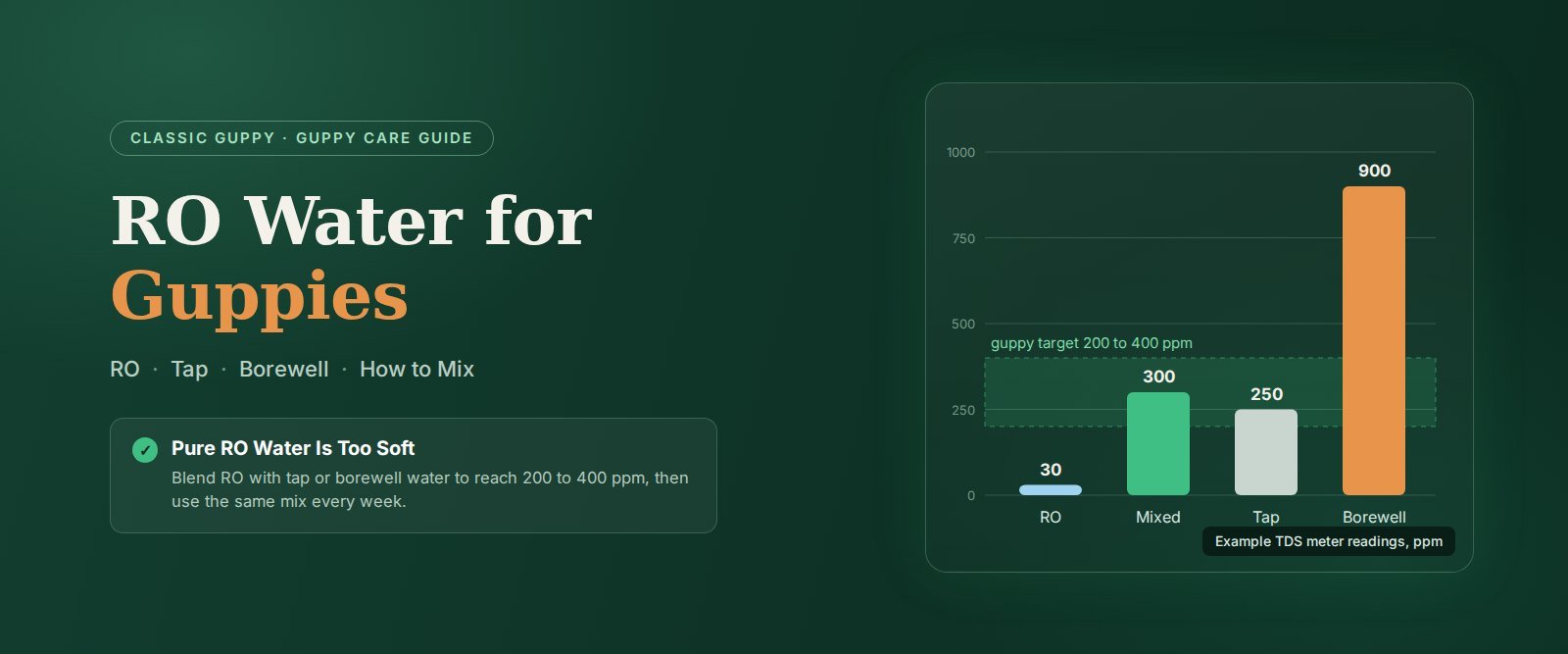
- Target TDS for guppies: roughly 200 to 400 ppm, with 150 to 500 ppm still workable.
- Borewell water is often hard and high in TDS. It can work, but often needs to be mixed down.
- Municipal tap water is often close to ideal once the chlorine is removed.
- Consistency matters more than the number. Keep new water within about 50 ppm of what is in the tank.
What a TDS Meter Actually Measures
TDS stands for total dissolved solids. A pen style meter does not count minerals directly. It measures how well the water conducts electricity and converts that into an estimate in parts per million.
That makes it a useful but limited tool.
- It tells you how much is dissolved, not what is dissolved. Calcium and magnesium raise TDS, but so do sodium, nitrate and fish waste.
- It is excellent for comparing two waters and for spotting drift between water changes.
- It does not replace a GH and KH test if you want to know actual hardness.
The table of ideal numbers, including GH and KH, is in our guppy water parameters guide. This guide focuses on the practical question of which water source to use.
Why Pure RO Water Is a Problem for Guppies
An RO membrane removes most of what is dissolved in water. That is good for drinking water with too much salt or contamination, but guppies evolved in hard, mineral rich streams. In very soft water several problems show up over time.
- Unstable pH. Without carbonate hardness to buffer it, pH can drop sharply between water changes. A sudden pH crash is one of the hidden reasons guppies die without warning. See our guide on why guppies die for the other common causes.
- Poor growth. Fry raised in very soft water often grow slowly and stay small.
- Stress signs. Clamped fins and a slow side to side shimmy are common in livebearers kept in soft water.
- Weaker colour and fins. Minerals support healthy fin and scale development.
Many RO purifiers have a TDS controller or mineral cartridge, so the output may read 50 to 120 ppm instead of near zero. That is better, but still below the guppy range.
Comparing Common Water Sources in India
| Source | Typical TDS | Good for guppies? | What to do |
|---|---|---|---|
| RO purifier output | 10 to 120 ppm | Too soft on its own | Mix with tap or add minerals |
| Municipal tap water | 100 to 350 ppm | Often ideal | Remove chlorine before use |
| Borewell water | 400 to 1500 ppm or more | Sometimes, often too hard | Test, then mix with RO |
| Packaged drinking water | 50 to 150 ppm | Variable | Check the label, usually soft |
| Rainwater | Below 50 ppm | Too soft | Avoid unless mixed |
| RO reject water | Higher than the input water | No | Do not use for tanks |
These are typical ranges, not promises. Water in the same city can vary widely between areas and even through the year. In the monsoon, borewell and tap water can change noticeably. That is why the only number that matters is the one you measure in your own home.
For context, India’s drinking water standard, IS 10500, sets an acceptable TDS limit of 500 mg per litre, and allows up to 2000 where no other source is available. Water can be within drinking limits and still be far from ideal for guppies.
How to Mix RO and Borewell Water
If your borewell water reads very high and your RO water reads very low, mixing them is the cheapest and most reliable fix. You can work out the ratio with simple maths.
Fraction of hard water needed = (target TDS minus RO TDS) divided by (hard water TDS minus RO TDS).
A worked example
- RO water reads 30 ppm.
- Borewell water reads 900 ppm.
- Your target is 300 ppm.
Fraction of borewell water = (300 minus 30) divided by (900 minus 30) = 270 divided by 870 = about 0.31.
So roughly one part borewell water to two parts RO water gives you about 300 ppm. For a 15 litre water change, that is about 5 litres of borewell water and 10 litres of RO water. Mix in a bucket, check the reading, and adjust with a little more of either before it goes into the tank.
Write down the ratio that works and use the same mix every time. Repeatability is what keeps guppies settled.
Remineralising Pure RO Water
If RO is your only source, you can add minerals back.
- GH and KH mineral salts sold for aquariums are the most controlled option. This guide to remineralising RO water suggests GH 8 to 12 and KH 4 to 8 for livebearers. Add slowly while checking TDS, and let the water settle for 10 to 15 minutes before taking a final reading.
- Crushed coral or cuttlebone in the filter or a mesh bag slowly adds calcium and carbonate hardness. It works, but the effect builds slowly, so test regularly.
- Mixing with tap water is the simplest option if your tap water is chlorinated but otherwise reasonable.
Avoid adding table salt to raise TDS. It raises the reading without adding the calcium and magnesium guppies actually need.
Tap Water: Usually the Easiest Option
In many cities, municipal tap water already sits close to the guppy range. Its main problem is chlorine or chloramine, which harms fish and kills beneficial bacteria. Either use a water conditioner or let water stand for 24 hours with an air stone if your supply uses plain chlorine. Our guppy fish water preparation guide covers this step by step.
Using Your TDS Meter Between Water Changes
Once your source water is sorted, the meter becomes a simple health check for the tank.
- Measure your source water and your tank water once a week.
- If tank TDS climbs steadily above your source water, waste is building up. A rise of 100 ppm or more usually means it is time for a water change.
- Keep each water change close to tank TDS. A sudden drop of 150 ppm or more in one go can stress fish, especially pregnant females.
Our guppy water change guide explains how much and how often to change.
Switching Water Sources Safely
Moving guppies from one water type to another should be gradual. If you are switching from borewell to a mixed supply, or moving to a new home with different water, change over across two to three weeks with smaller, more frequent water changes. The same applies when new guppies arrive, which is why our acclimation guide spends a full hour matching water slowly.
Frequently Asked Questions
Can guppies live in RO water?
Not in pure RO water for the long term. It lacks the minerals guppies need and lets pH swing. Mix it with tap or borewell water, or remineralise it.
What TDS is best for guppies?
Roughly 200 to 400 ppm suits most guppies. Values from 150 to 500 ppm are workable if they stay stable.
Is borewell water safe for guppies?
Often yes, but test it first. Very hard borewell water above about 600 ppm is usually better mixed with RO water.
Is 1000 TDS too high for guppies?
It is higher than ideal. Many guppies survive it, but mixing down towards 300 to 400 ppm usually gives better growth and fewer problems.
Can I use packaged drinking water for guppies?
You can, but it is usually soft and the mineral content varies by brand. It is an expensive way to get water that often still needs minerals added.
Should I use RO reject water in my aquarium?
No. Reject water carries the concentrated minerals and impurities removed from the input water.
The Short Version
RO water is not bad for guppies, but it is unfinished. Use a TDS meter to measure what comes out of your RO, your tap and your borewell, aim for roughly 200 to 400 ppm, and blend sources until you hit it. Then keep using the same recipe every week. Stable, mineral rich water does more for guppy health than any single perfect number.
Once your water is ready, browse our home bred strains in the Classic Guppy shop, all shipped across India with live arrival guaranteed, and read our guppy care guide for the rest of the setup.