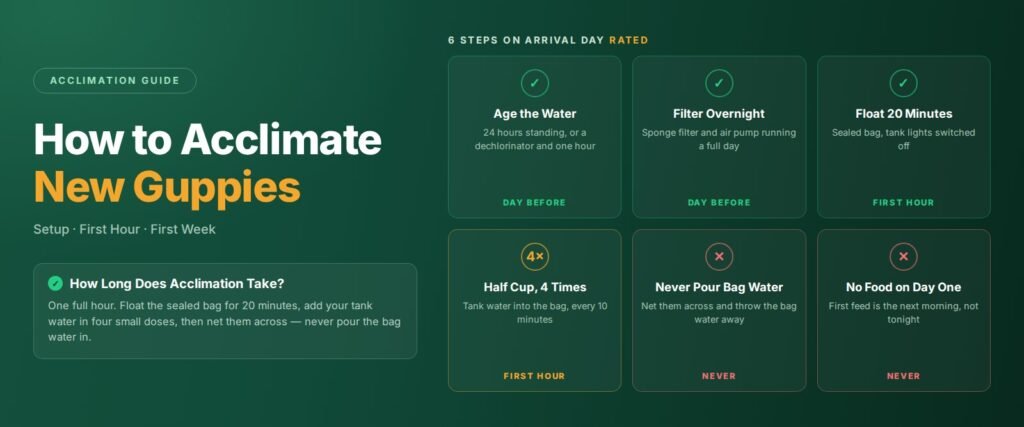
Most guppies that die in their first week were not sick when they left the breeder. They were rushed. If you want to acclimate guppies properly, the work starts a full day before the bag arrives and ends about an hour after it does. Get those two windows right and the fish settle, colour up by day two and start breeding within the month. Get them wrong and you spend the next fortnight treating problems you created on arrival day.
This is the exact process we give every Classic Guppy customer in Pune, written from shipping thousands of pairs across India. There is a free one-page PDF further down that you can print and keep beside the tank.
What You Need Before Your Guppies Arrive
The single most common mistake is buying the fish and the tank on the same day. A tank filled an hour before the guppies arrive has chlorinated water, no bacteria and an unstable temperature. Set everything up at least 24 hours ahead, and ideally a week ahead if you can cycle it.
| What | Minimum | Why it matters on day one |
|---|---|---|
| Tank | 1 ft / 40 L for a pair, 2 ft if you want fry | Small volumes swing in temperature and foul fast |
| Aged water | Standing 24 hours, or dechlorinated and rested 1 hour | Chlorine burns gills within minutes |
| Sponge filter + air pump | Running overnight before arrival | Fry-safe, and starts holding bacteria |
| Temperature | 24 to 28 °C, steady | Swings, not the number, are what kill |
| Heater | 25 W, winter only in most of India | Pune nights drop below 18 °C in December |
| Light | 6 to 8 hours a day on a timer | More grows algae, less dulls colour |
| Cover | Java moss, java fern or floating pothos | New fish hide for the first day, and fry need it |
Age the water for 24 hours
Fill the tank and leave it standing overnight with the air pump running. Chlorine gasses off on its own in about a day. If your supply is chloraminated, or you simply do not have a day, use a dechlorinator at the dose on the bottle and wait an hour before the fish go in. Never add fish to water straight from the tap. Our full method is in how to prepare guppy fish water.
Run the filter overnight
A sponge filter driven by an air pump is the right choice for guppies. It cannot suck in fry, it holds bacteria in the sponge, and it costs a few hundred rupees. Switch it on a full day before the fish come so the water is moving and oxygenated when they arrive. A single sponge covers a 1 ft tank, a double sponge suits a 2 ft or a fry tank. See sponge vs HOB vs canister if you are choosing.
Get the temperature steady, not perfect
Guppies are comfortable anywhere between 24 and 28 °C. What harms them is a tank that reads 27 °C in the afternoon and 20 °C at 5 am. Keep the tank off window sills and away from doorways. In a Pune or north Indian winter, a 25 W heater set to 26 °C holds the floor overnight. There is more in ideal guppy tank temperature and in do guppies need a heater, filter or air pump.
Plants and cover
Newly moved guppies hide. Give them somewhere to do it. Java moss, java fern or a handful of pothos roots trailing in from a bottle on the rim all work, need no CO2 and take nitrate out of the water. Our picks are in easy live plants for guppy tanks. Substrate is optional on day one, and a bare bottom is easier to keep clean for the first month if you are new. If you do want one, compare the options in sand vs gravel vs aquasoil.
Free Download: The One-Page Arrival Checklist
Everything on this page condensed onto a single A4 sheet: water ageing, the overnight filter, the hour-by-hour acclimation and the weekly water change. Print it, or keep it on your phone while you do the first hour.
How to Acclimate Guppies: The First Hour
The point of acclimation is not temperature alone. A bag that has travelled for hours has a different pH, a different hardness and a build-up of ammonia inside it. Your job is to move the fish from that water to yours slowly enough that nothing shocks them, and quickly enough that they are not sitting in fouled water while you do it. One hour is the sweet spot.
| Time | What you do | Why |
|---|---|---|
| 0 min | Switch the tank light off. Float the sealed bag. | Matches temperature without exposing the fish to light stress |
| 20 min | Open the bag, roll the top down, add half a cup of tank water | First small shift in pH and hardness |
| 30 min | Add another half cup | Second step |
| 40 min | Add another half cup | Third step |
| 50 min | Add another half cup | Bag is now mostly your water |
| 60 min | Net the fish across. Throw the bag water away. | Bag water carries ammonia and whatever travelled with it |
| Rest of day | Lights off, no food | Lets them find cover and settle |
A few details make the difference:
- Keep the bag sealed for the first 20 minutes. Opening it early lets warm air in and does nothing useful.
- Roll the top of the bag down into a collar once it is open so it floats upright and cannot tip.
- If the bag is nearly full and adding water would overflow it, pour a little of the bag water down the sink first, then continue. Never pour it into the tank.
- Use a soft net, not your hands, and keep the fish out of the air for the shortest time you can.
- Leave the tank light off for the rest of the day and do not tap the glass.
Why floating the bag alone is not enough
Floating equalises temperature and nothing else. If your tank sits at pH 7.8 and the bag has drifted to 7.0 after a day in transit, dropping the fish straight in swings the pH by nearly a full point in a second. That is what causes the clamped fins, the shimmying and the deaths that show up two days later, long after most people have stopped connecting them to arrival day.
Drip acclimation, if you prefer it
Drip acclimation does the same job more gradually. Empty the bag and fish into a clean container, run a length of airline tubing from the tank, tie a loose knot in it to slow the flow to two or three drops a second, and let it run until the volume in the container has roughly tripled. It usually takes 45 to 60 minutes. It is worth doing for long-distance shipments or if you know your water is very different from the seller’s. For a same-day delivery inside a city, the cup method above is enough.
The First 24 Hours
Expect them to look disappointing. Newly moved guppies go pale, hold their fins close to the body and sit near the bottom or hide in the plants. That is normal and it is not a disease. Colour usually returns within 24 to 48 hours as they relax.
Do not feed them on arrival day. A fish that has been bagged has an empty gut and food that goes uneaten becomes ammonia in a tank with no established bacteria. The first feed is the next morning, and it should be a pinch small enough to be gone in two minutes. Skipping one day does no harm at all.
Do not add medicine, salt or a stress coat product as a precaution. Dosing a healthy fish that is simply tired is one of the fastest ways to lose it. If something genuinely looks wrong, send us a short video on WhatsApp before you treat anything.
The First Week
- Feed twice a day, a pinch each time, entirely eaten within two minutes. Leftover food is the most common killer of new guppies.
- Change 30% of the water once a week, at the same temperature as the tank and dechlorinated.
- Leave the filter alone. Do not rinse the sponge in the first month, and when you do, squeeze it in old tank water, never under the tap.
- Keep the light to 6 to 8 hours on a timer.
- Do not add more fish yet. Give the tank three to four weeks before the next batch, and quarantine anything that comes from a different source.
Water Changes After the First Week
Once a week, 30%, same temperature, always dechlorinated. That single habit does more for colour, growth and fry survival than any product you can buy. Siphon from the bottom so you take waste out with the water rather than just skimming clean water off the top, and refill slowly.
Never do a 100% change. Stripping the tank removes the bacteria colony along with the water and restarts the cycle, which is how people end up with an ammonia spike a week after a “deep clean”. Small and regular beats big and occasional. The full schedule by tank type is in our guppy water change guide.
Mistakes That Kill Newly Bought Guppies
| Mistake | What happens | Do this instead |
|---|---|---|
| Tank filled the same day | Chlorine burn and no bacteria | Set up 24 hours ahead, minimum |
| Pouring the bag water in | Ammonia and anything that travelled with it enter your tank | Net the fish across, bin the water |
| Feeding on arrival day | Uneaten food rots and spikes ammonia | First feed the next morning |
| Lights on to “watch them” | Prolongs stress, delays settling | Lights off until the next day |
| Preventive medicine or salt | Stresses a fish that was only tired | Observe for 48 hours first |
| Adding more fish in week one | Bioload outruns the young filter | Wait three to four weeks |
| Washing the sponge under the tap | Chlorine kills the bacteria colony | Squeeze it in old tank water |
What Is Normal and What Is Not
| What you see | Normal? | What to do |
|---|---|---|
| Pale colour, hiding, day one | Normal | Lights off, leave them alone |
| Fins held close to the body for a few hours | Normal | Check temperature is steady, then wait |
| Not eating on the first morning | Normal | Remove uneaten food, try again in the evening |
| Sitting on the bottom on day three | Not normal | Test the water, check temperature, send us a video |
| White spots like grains of salt | Not normal | Likely ich, see our guppy diseases guide |
| Gasping at the surface | Not normal | Increase aeration, check for an ammonia spike |
If losses continue past the first few days, work through why are my guppies dying before you reach for medication.
Frequently Asked Questions
How long does it take to acclimate guppies?
One hour for the cup method: 20 minutes floating sealed, then four small additions of tank water ten minutes apart, then net them across. Drip acclimation takes 45 to 60 minutes. Anything under 30 minutes is a rush.
Can I put guppies straight into a new tank?
No. Even if the temperature matches, the pH and hardness will not, and an uncycled tank has no bacteria to handle their waste. Age the water for at least 24 hours with the filter running, then acclimate over an hour.
Should I feed guppies on the day they arrive?
No. Feed for the first time the next morning. A day without food does not harm an adult guppy, but uneaten food in a brand new tank causes an ammonia spike that can.
Why are my new guppies hiding and pale?
Transport stress. It is the normal response to being bagged and moved, and colour typically returns within 24 to 48 hours. Keep the light off, resist feeding heavily and give them plants to hide in.
Do I need to quarantine guppies from a breeder?
If the tank is new and these are your first fish, no separate quarantine tank is needed, since the whole tank is effectively quarantine. If you are adding to an established tank, keep the new fish separate for two weeks.
How many guppies should I start with?
One pair per 1 ft of tank, or two feet of tank if you intend to keep the fry. Starting small lets the filter mature alongside the bioload. Before mixing species, read guppy tank mates.
When will they start breeding?
Often within two to four weeks of settling in, and many females arrive already gravid. Watch for the signs in our pregnant guppy guide.
The Short Version
Age the water for 24 hours. Run the sponge filter overnight. Float the sealed bag for 20 minutes with the lights off, add half a cup of your tank water four times ten minutes apart, then net the fish across and throw the bag water away. No food until the next morning. Then 30% water change every week, same temperature, forever. That is the whole thing, and it is why fish that leave here healthy stay that way.
Anything that looks wrong in the first week, send a short video to WhatsApp +91 72498 87278 and we will tell you what we are seeing. For everything beyond arrival day, start with our complete guppy care guide.