Guppy tank mates are easy to get wrong. Guppies are small, slow and trail a long fin that every semi-aggressive fish in the shop wants to bite. Get the choice right and you have a calm, colourful community tank that almost runs itself. Get it wrong and you lose fish, fins and fry within a week. Here is what actually works, what to avoid, and how many fish your tank can really hold.
The Three Rules for Choosing Guppy Tank Mates
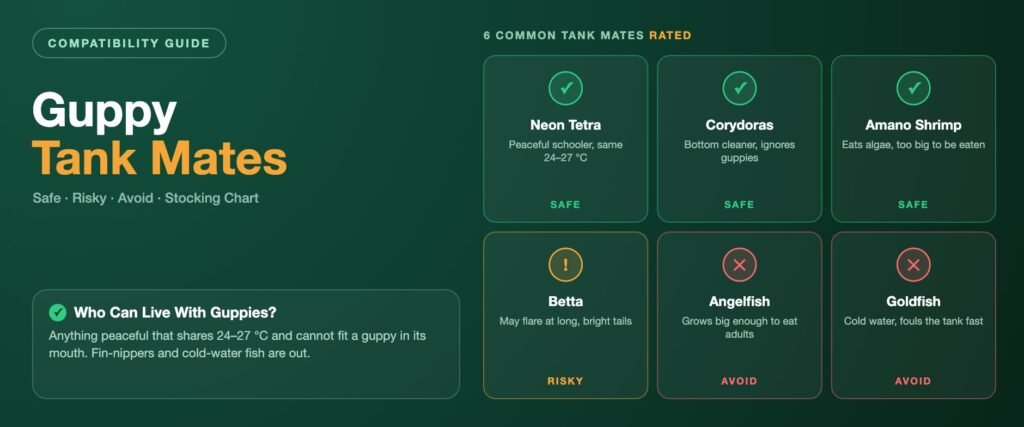
Almost every compatibility question answers itself once you apply three tests. A good tank mate shares the guppy’s water, shares its temperament, and cannot fit a guppy in its mouth.
- Same water: 24–27 °C, pH 7.0–7.8, moderately hard. Cold-water and soft-water blackwater fish are out.
- Same temperament: peaceful, not territorial, and no history of fin-nipping.
- Right size: an adult mouth smaller than an adult guppy — roughly under 7 cm for anything that swims in open water.
If you are still setting the tank up, fix the water first; the ideal guppy tank temperature guide and how to prepare guppy fish water cover the numbers every species in the table below has to share.
Best Guppy Tank Mates
| Tank mate | Adult size | Temperature | Why it works |
|---|---|---|---|
| Neon tetra | 3 cm | 22–26 °C | Peaceful schooler; run the tank at 24–26 °C to suit both |
| Cardinal tetra | 4 cm | 24–28 °C | Warmer-water cousin, an even closer temperature match |
| Ember tetra | 2 cm | 23–28 °C | Tiny, calm, adds colour without competing |
| Corydoras (pygmy, panda, bronze) | 3–6 cm | 23–27 °C | Bottom feeder, cleans leftovers, never looks up |
| Otocinclus | 4 cm | 23–27 °C | Algae grazer, completely harmless |
| Platy and molly | 5–8 cm | 24–28 °C | Same livebearer needs; will eat stray fry |
| Harlequin rasbora | 4 cm | 23–28 °C | Quiet schooler, no interest in guppy tails |
| Amano & cherry shrimp | 2–5 cm | 22–28 °C | Cleans algae and waste; adults are too big to eat |
| Nerite & mystery snail | 2–5 cm | 22–28 °C | Glass and leaf cleaners, zero aggression |
| Kuhli loach | 8–10 cm | 24–28 °C | Nocturnal, hides in the substrate, mouth too small |
Of all the guppy tank mates on that list, corydoras catfish are the safest single choice. They work the bottom of the tank where guppies never go, they eat the food that would otherwise rot into nitrate, and they are completely indifferent to a guppy’s tail. Keep them in groups of six or more or they hide all day. Neon tetras are the other classic pick, though they naturally sit a little cooler — Seriously Fish lists 21–25 °C for them — so hold the tank at 24–26 °C and both species stay comfortable.
Shrimp, Snails and Fry
Adult amano and cherry shrimp are safe with guppies, but baby shrimp are eaten exactly like guppy fry. If you want a shrimp colony to grow, give them dense moss and plants to hide in — the same cover that saves your fry. The easy live plants for guppy tanks list covers the species that do this best with the least work.
Tank Mates to Avoid
These are the guppy tank mates behind most of the “my guppy’s tail is shredded overnight” posts. Some are simply predators. Two of them are gambles that go wrong often enough that no show-quality male should be risked on them.
| Fish | Verdict | What goes wrong |
|---|---|---|
| Goldfish | Avoid | Wants 18–22 °C and produces far more waste than a guppy tank can process |
| Tiger barb | Avoid | Classic fin-nipper; shreds long tails within days |
| Angelfish & larger cichlids | Avoid | Grow big enough to swallow an adult guppy |
| Oscar, jack dempsey | Avoid | Predators — guppies are literally sold as their feeder fish |
| Common pleco | Avoid | Reaches 30 cm+ and may rasp at slow-moving fish at night |
| Serpae tetra, black skirt tetra | Avoid | Nippy in small groups, targets flowing fins |
| Betta | Risky | Some ignore guppies; many attack bright, long-finned males |
| Dwarf gourami | Risky | Peaceful until it becomes territorial at breeding age |
| Crayfish | Avoid | Catches sleeping fish at night |
Can Guppies Live With a Betta?
Sometimes — and that is exactly the problem. A betta reads a bright, long-finned male guppy as a rival and a slow one as an easy target. If you want to try it, use a tank of at least 60 litres, keep female guppies or short-finned males only, plant it heavily so sight lines are broken, and have a second tank ready. Watch for clamped fins and torn tails in the first 48 hours. Females and short-finned strains survive the pairing far more often than a show-tailed male ever will.
How Many Guppies Per Tank Size?
The old “one inch of fish per gallon” rule overstocks guppies badly, because guppies breed. Plan for the fry, not just the adults you buy today.
| Tank size | Guppies only | With tank mates | Notes |
|---|---|---|---|
| 10 L / 2.5 gal | Not recommended | None | Too small to hold stable temperature and ammonia |
| 20 L / 5 gal | 3–4 (all one sex) | + 5 cherry shrimp | Single-sex only, or fry will overrun it |
| 40 L / 10 gal | 6–8 | + 6 pygmy cory or 8 shrimp | The realistic starter size |
| 60 L / 15 gal | 10–12 | + 8 neon tetra and 6 cory | Comfortable community tank |
| 110 L / 29 gal | 18–22 | + 2 schooling species and cleanup crew | Room to grow out a spare brood |
Two more numbers matter as much as the totals. Keep one male to two or three females so no female is chased constantly, and remember that each female can add 20–60 fry a month — see guppy breeding time for how fast that compounds. An all-male tank is the standard answer for keepers who want colour without a population explosion.
Adding New Tank Mates Safely
- Quarantine for two weeks in a separate tank. Most guppy disease outbreaks arrive on a new fish, not out of nowhere.
- Match the temperature and drip-acclimate over 30–45 minutes rather than dumping the bag in.
- Add schooling fish as a full group, not two at a time — small groups nip, full groups do not.
- Rearrange the plants before adding anything, so no fish is defending old territory.
- Watch the first 48 hours. Torn tails, clamped fins or a guppy hiding at the surface means the pairing is failing; see the guppy disease guide if damage has already started.
Also check that your filtration keeps up with the extra stock. A tank that was fine with eight guppies can crash when you add a school of tetras — the guppy filter guide covers what each type can actually handle.
Frequently Asked Questions
What is the best tank mate for guppies?
Corydoras catfish are the best of the guppy tank mates for a beginner. They live on the bottom, clean up uneaten food, need the same 24–27 °C, and have no interest in guppy fins. Keep six or more.
Can guppies live alone?
They can survive alone but they are a shoaling fish and colour up far better in a group. Three or more of the same sex is the sensible minimum.
Will guppies eat shrimp?
They will eat baby shrimp, not adults. A planted tank with moss lets a cherry shrimp colony keep breeding alongside guppies.
Do guppies eat their own fry?
Yes, and so does every tank mate on the safe list. In a community tank expect 20–40% fry survival unless you use dense plants or a breeding box.
How many guppies can live in a 10-gallon tank?
Six to eight adults, or five adults plus a small cleanup crew. Keep them single-sex, or plan where the fry will go.
Can guppies live with goldfish?
No. Goldfish want cooler water, grow much larger, and produce a waste load that pushes guppies into fin rot within weeks.
Pick peaceful fish that share the guppy’s water, stock for the fry you will get rather than the fish you buy, and quarantine everything new. Do that and guppy tank mates stop being a gamble — the complete guppy care guide covers the rest of the routine.
Once you have settled on tank mates, get the guppy stocking itself right too. Our guide to the male to female guppy ratio explains why 1:3 works best.