A practical, guppy-specific guide to choosing between sponge, HOB and canister filters so your fry stay safe and your water stays clean.
Why Filtration Matters for Guppy Tanks
Guppies are hardy, but they still produce a steady load of waste that can spike ammonia and nitrite in a small tank. A good filter keeps the water column clear, houses the beneficial bacteria that break down waste, and creates enough gentle water movement to keep oxygen levels healthy without blasting your fry across the tank. Filtration matters even more in a breeding setup, where waste from several generations of guppies can overwhelm an undersized filter within days. The filter type you pick also determines how much manual maintenance the tank needs and how safe it is for the smallest fish in it, which is why type matters as much as tank size.
Sponge Filters
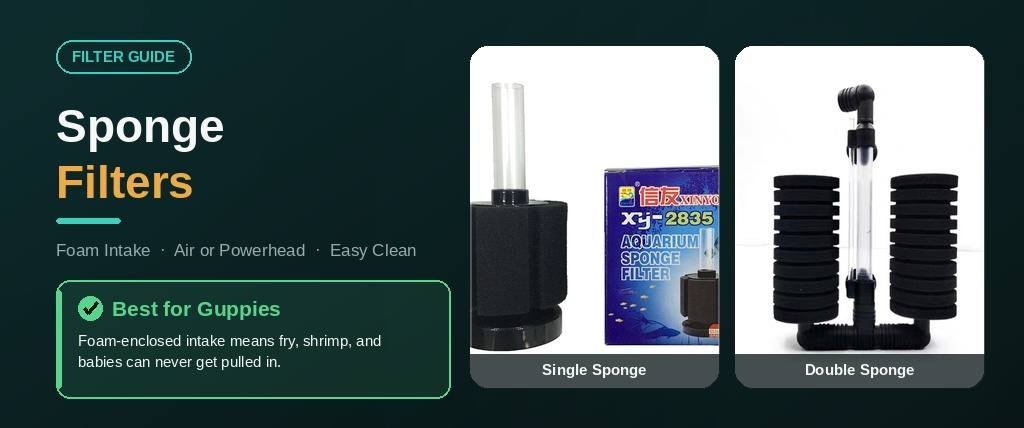
Sponge filters are the go-to choice for guppy breeders because the intake is completely enclosed in foam, so fry, shrimp, and even newborn guppies can’t get pulled in. They’re air or powerhead driven, inexpensive, and easy to squeeze clean in a bucket of tank water. The trade-off is comparatively gentle flow, so in larger or heavily stocked tanks you may want to run two.
A single sponge filter typically costs under $15 and runs on a basic air pump, which also adds gentle aeration to the tank. Because the sponge itself is the filter media, it builds a dense bacteria colony within a few weeks, and squeezing it out in old tank water during a water change is enough upkeep for most setups. The main limitation is mechanical filtration — sponge filters catch large debris but won’t polish water as clear as a fine floss pad, so many guppy keepers pair one with regular gravel vacuuming.
Hang-On-Back (HOB) Filters
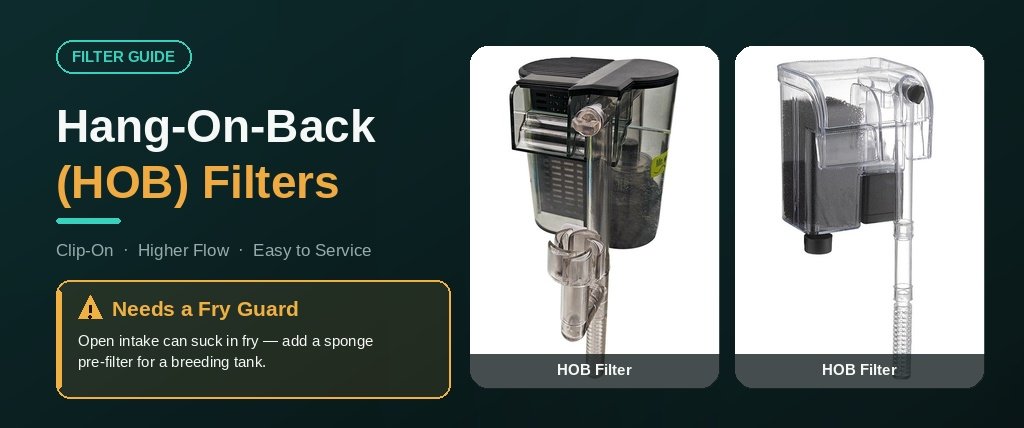
HOB filters clip onto the back of the tank and combine mechanical and biological filtration in one cartridge. They’re simple to install, easy to service, and offer more flow and surface agitation than a sponge filter. For a guppy tank, choose one with an adjustable flow rate or add a pre-filter sponge over the intake so fry aren’t drawn in.
Replacement cartridges make HOB filters convenient, though swapping the whole cartridge at once can wipe out a large share of the bacteria colony — it’s better to rinse the existing media and only replace floss once it’s visibly worn. The stronger surface agitation helps oxygenate a heavily stocked tank, but that same current can push fry into corners or tire them out, which is why breeders either turn the flow down or shield the intake with a sponge pre-filter.
Canister Filters
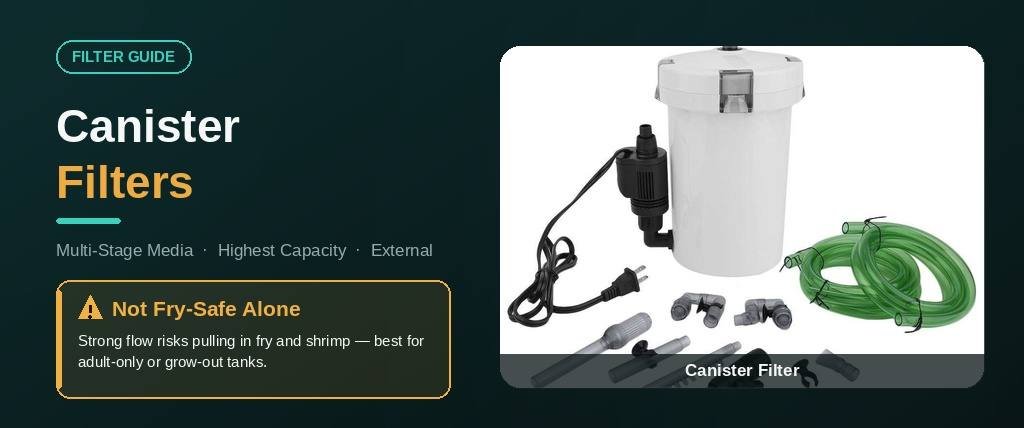
Canister filters sit outside the tank and pump water through several stages of mechanical, biological, and chemical media. They offer the highest filtration capacity and the longest gap between cleanings, which makes them worth it for larger community or breeder setups. They cost more up front, but a fry guard on the intake is essential if you keep breeding guppies.
Because the canister sits below or beside the tank, it can hold far more filter media than a sponge or HOB filter, supporting a larger bacteria colony and cleanings that are often needed only once a month. The trade-off is setup complexity: priming the tubing, adjusting flow, and rinsing several media baskets takes more time than squeezing a sponge, and the strong intake will pull in an unguarded fry within seconds if it isn’t fitted with a strainer or fry guard.
Which Filter Is Actually Best for Guppies?
For a dedicated guppy or breeding tank, the sponge filter is the safest overall choice. Its fully enclosed foam intake makes it physically impossible for fry, shrimp, or a curious adult guppy to get pulled in, and its gentle output won’t exhaust fish that aren’t strong swimmers yet. HOB filters are a solid choice for a guppy tank that isn’t also a nursery, since their intake still poses a real risk to newborn fry unless you add a foam pre-filter. Canister filters are the least fry-safe of the three on their own — their strong intake is built for large volumes of water and will draw in anything small enough to fit through the strainer, which is why they work best in adult-only display tanks or alongside a sponge filter in a breeding setup. If fry safety is the priority, sponge wins; if raw capacity for a larger, established tank is the priority, canister wins, with HOB in between for community tanks that aren’t actively breeding.
Which Filter Fits Your Tank Size
Tank size alone doesn’t decide the right filter, but it narrows the options once you’ve picked the safest type for your situation and maintenance schedule.
- 1 ft / small tanks (under 10 gallons): a single sponge filter is usually enough.
- 2 ft tanks: a sponge filter plus a small HOB, or one mid-size HOB filter with an adjustable flow.
- 3 ft tanks: a HOB filter rated above the tank’s volume, or a small canister filter for extra stability.
- Breeder or fry grow-out tanks: always use a sponge filter or a covered intake, never an open HOB or canister intake where fry can be pulled in.
Filter Maintenance Tips
A few habits keep any filter type running well without crashing the bacteria colony doing the real work.
- Rinse sponge and mechanical media in old tank water, never tap water, to protect the bacteria colony.
- Clean only one filter, or one media basket, at a time if you run multiples, so the colony never crashes completely.
- Replace mechanical floss more often than biological media, since bacteria live mainly in the sponge and ceramic media.
- Test ammonia and nitrite after a big cleaning, especially in a heavily stocked breeding tank, to confirm the colony bounced back.
Frequently Asked Questions
Do guppies need a filter?
Yes. Even in a heavily planted tank, a filter keeps ammonia and nitrite from building up and gives beneficial bacteria a place to colonize.
Can baby guppies get sucked into a filter?
They can with an uncovered HOB or canister intake. Use a sponge filter or fit a foam pre-filter over any intake in a tank with fry.
How many filters does a guppy tank need?
One appropriately sized filter is enough for most tanks. Many breeders run two smaller filters so a healthy bacteria colony always survives when one is cleaned.
What’s the best filter for a guppy fry tank?
A sponge filter is the safest choice for a dedicated fry or breeding tank — there’s no intake strong enough to pull fry in, and the gentle flow won’t tire them out.
With filtration sorted, you’re ready to stock your tank — browse our home-bred guppy strains. If algae has crept in despite good filtration, see our algae guide for the fix.