Guppy breeding time is the one number that decides how fast a strain moves. A healthy female carries a brood for roughly 28 days, drops 20–60 fry, and can be ready to breed again within hours of giving birth. Hold the water steady and that cycle repeats 10–13 times a year. Let the tank swing cold and the same female may give you only five or six broods. Here is the full picture — cycle length, how many times a year guppies breed, the weather and water that suit them best, and when a breeding box actually helps.
Guppy Breeding Time at a Glance
- Gestation (breeding cycle): 21–31 days, about 28 days at a steady 26 °C
- Broods per year: 10–13 in a heated tank, 5–8 in an unheated one
- Fry per brood: 20–60 (the first brood is usually only 8–20)
- Female ready to breed: 2.5–3 months old, around 3 cm
- Male ready to breed: 4–6 weeks, as soon as the gonopodium forms
- Best breeding temperature: 25–27 °C
- Best breeding ratio: 1 male to 2–3 females
How Long Is One Guppy Breeding Cycle?
Guppies are livebearers, so there are no eggs to watch. The male fertilises the female with his gonopodium, the female stores the sperm, and the fry develop inside her. From that moment the clock runs for about four weeks. You will see the gravid spot behind her belly darken from a faint grey patch to a deep black square, her body squares off, and she starts hiding near the heater or in a corner. That is the last 48 hours.
Temperature is what stretches or shortens that window. Warm water speeds up the fry’s development; cool water slows everything down and often ends in a smaller, weaker brood. This is why guppy breeding time is really a temperature question more than a calendar question.
| Water temperature | Breeding cycle | Broods per year | What actually happens |
|---|---|---|---|
| 22 °C | 33–40 days | 6–8 | Slow gestation, small broods, many stillborn fry |
| 24 °C | 30–33 days | 8–10 | Safe but slow; fry colour up late |
| 26 °C | 27–29 days | 11–13 | The sweet spot — biggest, healthiest broods |
| 28 °C | 22–25 days | 12–14 | Fastest turnover, but a shorter adult lifespan |
| 30 °C and above | 20–23 days | 10–12 | Stress, low oxygen, weak males, deformed fry |
Chasing 28 °C for speed is the classic beginner trap. You gain two extra broods a year and lose several months off every fish in the tank. A stable 26 °C gives you nearly the same output with far better fish — see the ideal guppy tank temperature guide for how to hold it through the day.
How Many Times a Year Do Guppies Breed?
On paper, 365 days divided by a 28-day cycle gives 13 broods a year. In a real breeding tank the honest number is 10 to 12 broods a year, because a female skips a cycle after a heavy drop, after a move, or after a big water change. One well-fed female at 26 °C will therefore produce roughly 300–600 fry in a year, and a trio of one male and two females can fill a 10-gallon grow-out tank in four months.
Serious breeders deliberately take less. After four or five back-to-back broods, a female is moved to a quiet, lightly stocked planted tank for six to eight weeks. She recovers her body shape, and her next broods come out larger and stronger than they would have been if she had been bred non-stop.
One Mating, Many Broods
A female guppy stores sperm for months and can deliver three to six broods from a single mating. This is why a female-only tank suddenly fills with fry, and why a pet-shop female almost never breeds true to your male. If strain purity matters to you, raise virgin females — separate the sexes the moment the males show a gonopodium, at around three to four weeks. The full method is in how to choose a female guppy for a superior strain.
Guppy Breeding Age: When Are They Ready?
| Age | Stage | What to do |
|---|---|---|
| 0–3 weeks | Fry, no visible sex | Feed 4–5 small meals daily, 30% water change weekly |
| 3–5 weeks | Males show a pointed gonopodium | Separate the sexes now to keep the line clean |
| 6–8 weeks | Males fully fertile, colour rising | Grow them out; do not pair yet |
| 10–12 weeks | Females mature, gravid spot clear | First safe pairing age |
| 3–8 months | Prime breeding window | Best fry counts and strongest colour transfer |
| 12 months and older | Output falls | Retire to a display tank; keep only proven pairs |
Breeding a female at eight weeks is possible but costly: the brood is tiny, the fry are weak, and the female often stays stunted for life. Waiting until 12 weeks costs you one cycle and buys you a much better breeder. To see how quickly your own fry reach that point, the guppy growth timeline maps it week by week.
The Perfect Weather and Water for Breeding
Indoors, with a heater, guppies breed all year round. Outdoors — in tubs, ponds and unheated rooms — they follow the weather closely. Breeding rises sharply once the water sits above 24 °C, peaks in warm and stable conditions, and almost stops below 20 °C. What guppies really dislike is not warm or cool water but a swinging temperature, which is exactly what open windows, monsoon rain and unheated winter nights create.
| Parameter | Ideal for breeding | Why it matters |
|---|---|---|
| Temperature | 25–27 °C, under 1 °C daily swing | Sets the length of the whole breeding cycle |
| pH | 7.0–7.8 | Low pH delays drops and softens fry |
| Hardness | 8–12 dGH (150–250 ppm) | Bone and fin development in fry |
| Ammonia and nitrite | 0 ppm | Any reading stops breeding outright |
| Nitrate | Under 20 ppm | High nitrate causes stillborn broods |
| Light | 8–10 hours on a timer | A regular day length keeps cycles regular |
| Water change | 25% weekly, temperature matched | Cold top-ups trigger premature births |
Prepare and age new water before it ever touches a gravid female; the method is in how to prepare guppy fish water.
Season-by-Season Breeding Plan
| Season | Room conditions | What to do | Broods per female |
|---|---|---|---|
| Spring (Feb–Apr) | 24–28 °C, stable | The best pairing window of the year; set up breeding trios now | 3 |
| Summer (May–Jun) | 30 °C and above | Shade the tank, add surface agitation, cut light to 8 hours | 2–3 |
| Monsoon (Jul–Sep) | 25–28 °C, swinging | Watch pH and oxygen; keep the heater on to stop night dips | 2–3 |
| Winter (Nov–Jan) | 14–22 °C | Heater at 26 °C, insulate the tank, feed lightly | 1–2 |
Guppy Breeding Box: When It Helps and When It Hurts
A breeding box — the small plastic trap that hangs inside the tank — saves fry, but only if you use it for a day or two. Netting a female a week early and leaving her in a cramped box is the most common cause of premature, stillborn broods. Move her when the gravid spot is deep black and squared off, keep the box shaded, and return her to the main tank the moment she has dropped.
| Method | Best used for | Fry saved | Main risk |
|---|---|---|---|
| Plastic breeding box | The final 24–48 hours | 90% and up | Stress and premature birth if used too early |
| Mesh breeder net | 2–3 days, gentler than a box | 85–95% | Needs good flow through the mesh |
| Separate birthing tank (5–10 L) | Serious breeders and show lines | 95% and up | Needs its own heater and sponge filter |
| Heavily planted tank, no box | Casual keepers | 20–40% | Adults eat most of the fry |
Whichever method you pick, the fry need to be feeding within hours of birth. The guppy breeding care guide covers cage setup and feeding schedules, and fast-growing guppy fry covers the first eight weeks in detail.
Your Breeding Pair Should Look Like This
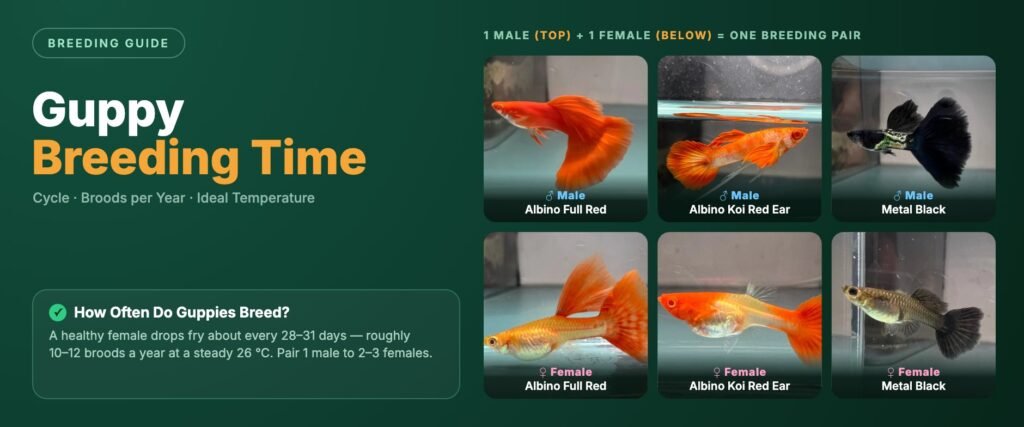
Breeding time is wasted on the wrong pair. Look at the banner above: the male sits at the top of each column and the female below him, and both come from the same strain. Pair one male with two or three females so that no single female is chased all day.
| What to check | Male | Female |
|---|---|---|
| Age at pairing | 3–6 months | 3–6 months |
| Body | Straight spine, broad shoulders | Deep, wide body — carries bigger broods |
| Fins | Wide tail carried open, full dorsal | Clean fins, no clamping |
| Colour | Deep and even — he sets the fry’s colour | Same strain; colour at the tail base is a bonus |
| Behaviour | Actively courting, never hiding | Feeding hard, not shy |
Selection is where a line is won or lost. Read how to choose the perfect guppy breeding pair before you set up your first trio.
Mistakes That Waste Breeding Time
- Running the tank at 28 °C or higher to force faster broods
- Netting the female into a breeding box a week before she is due
- Topping up with cold tap water, which triggers early drops
- Breeding females before 10 weeks, which stunts them permanently
- Assuming a new female is virgin — she may carry stored sperm for months
- Leaving fry with the adults and calling a 20% survival rate normal
Frequently Asked Questions
How long is a guppy pregnant?
About 28 days at 26 °C. The realistic range is 21 to 31 days, stretching towards 40 days in cool water below 22 °C.
How many times a year do guppies give birth?
Ten to twelve times a year in a heated, stable tank. In an unheated tank that follows room temperature, expect five to eight broods a year, almost all of them in the warm months.
Can a guppy give birth without a male in the tank?
Yes. Stored sperm lets her produce three to six broods over several months after the male has been removed or sold.
What temperature stops guppies from breeding?
Breeding slows badly below 22 °C and effectively stops under 20 °C. Above 30 °C males often turn infertile and broods come out small and deformed.
How long should a guppy stay in a breeding box?
No more than 24 to 48 hours. Put her in when the gravid spot is black and squared off, and take her out as soon as the fry are dropped.
How many fry does a guppy have the first time?
Usually 8 to 20. Brood size climbs with each cycle and peaks at 40 to 60 fry somewhere between her third and sixth brood.
Get the temperature steady, pair young adults from one strain, and use the box only at the end — do that and guppy breeding time becomes predictable enough to plan a whole year of fry around it.