
Most breeders obsess over the male guppy’s tail, yet the female is the one who truly sets the ceiling for a bloodline. She carries half the genetic code, passes on body shape and hidden colour genes that may not show in her own scales, and decides how many strong fry survive each drop. Picking a female by looks alone is the fastest way to stall a breeding project. Here is how to judge a female properly before she ever enters a breeding tank.
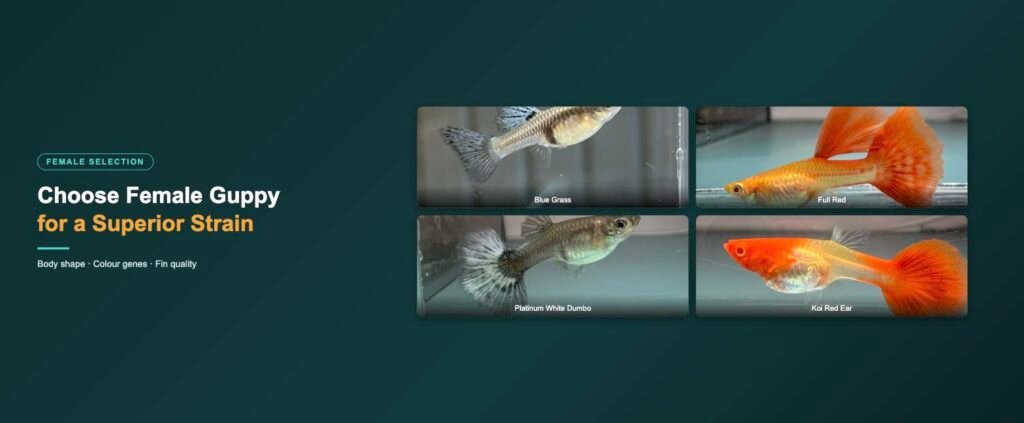
Why the Female Decides Your Strain’s Future
Genetics in guppies do not always show themselves the same way in both sexes. A female can carry vivid colour and pattern genes on her X chromosomes without displaying them herself, then pass those traits on to a portion of her sons and daughters. This is why two males can look identical yet throw very different fry depending on which female they are paired with. If you want a strain that improves generation after generation, the female’s pedigree deserves as much attention as the male’s finnage.
Start With Body Shape, Not Colour
Before looking at colour at all, study the female’s outline from above and from the side. A strong breeding female has a smooth, slightly rounded belly, a straight spine, and shoulders that are neither pinched nor swollen. Avoid females with a humped back, a sunken stomach, or a body that looks too long and thin for her width. Body shape is one of the most heritable traits in guppies, and a female with poor conformation will often pass that fault to fry even when paired with a perfectly shaped male.
Reading Colour and Pattern in a Duller Fish
Females carry far less colour than males, so you have to look closely rather than for a big display. Check the edges of the tail and dorsal fin for any wash of the target colour, look at the iridescence on the shoulder scales under good light, and compare siblings from the same spawn side by side. A female with even a faint, clean trace of the pattern you are breeding for is usually a better genetic match than one with no trace at all, even if neither looks impressive on its own.
Fins, Carriage and Symmetry
A female’s fins will never match a male’s for size, but they still tell you a great deal. Look for a dorsal fin that sits upright and is well formed rather than folded or ragged, and a tail that opens evenly with no pinched or twisted rays. Watch how she swims: a female that holds her fins tight to her body, swims in short jerky bursts, or drags a fin along the substrate is telling you something is wrong, whether genetic or related to poor health.
Age, Virginity and Timing
For controlled breeding, always start with a virgin female, since guppies store sperm and a female bought from a mixed tank may already be carrying fry from an unknown, often lower quality male. The ideal window is a semi-adult female around eight to twelve weeks old, old enough to show her adult shape and colour traces but young enough to guarantee she has not been near a mature male. Separate young females from males the moment you can tell the sexes apart if you plan to use them for planned pairings later.
Health and Vigour Checklist
No amount of good genetics matters if the female cannot carry a healthy brood. Choose fish that swim actively in open water, hold all fins unclamped, and show bright red gills rather than pale or brown ones. Her body should look full without being swollen unevenly, and the gravid spot near her vent should look normal for her stage rather than dark, distended or lopsided. Skip any female sharing a tank with visibly sick fish, even if she looks fine herself.
Pairing Her With the Right Male
A great female is wasted on a random male. Match her to a male from a related, proven line so that the traits you value are reinforced rather than diluted, while keeping enough genetic variety to avoid the weak fry and low fertility that come from breeding overly close relatives repeatedly. Keep simple records of each pairing and its results so you can identify which females consistently throw the strongest fry over several spawns.
Mistakes That Ruin a Breeding Program
The most common error is selecting females purely on whatever colour is visible, while ignoring body shape and health entirely. A close second is using females straight from a community tank without knowing their breeding history, and a third is starting breeding too early with immature females that produce small, weak first spawns. Slow down, compare several candidates side by side, and let conformation and vigour guide the final decision as much as colour does.
Simple Habits That Make Selection Easier
A few habits make female selection far less guesswork. Photograph candidates under the same light each time. Consistent light stops shadows and glare from hiding true colour and shape. Keep every prospective female in a bare-bottomed tank for a week before judging her. Bare glass and clean water make faults in shape or fin condition much easier to spot than a heavily planted display tank. Write down basic details for each female you shortlist, including her spawn date, her mother’s traits, and your first impression. A simple notebook or spreadsheet becomes valuable once you are comparing dozens of females across several generations. Finally, always quarantine new females away from your main breeding stock for at least two weeks, since even a healthy-looking fish can introduce parasites or disease that undo months of careful selection work.
Final Thoughts
Choosing a female guppy for a superior strain is less about finding the prettiest fish in the tank and more about reading the traits that will actually carry forward into the next generation. Prioritise body shape, hidden colour genes, fin symmetry, age and health in that order, and pair her thoughtfully with a suitable male. Breeders who take this approach consistently see steadier improvement in their line than those chasing colour alone.