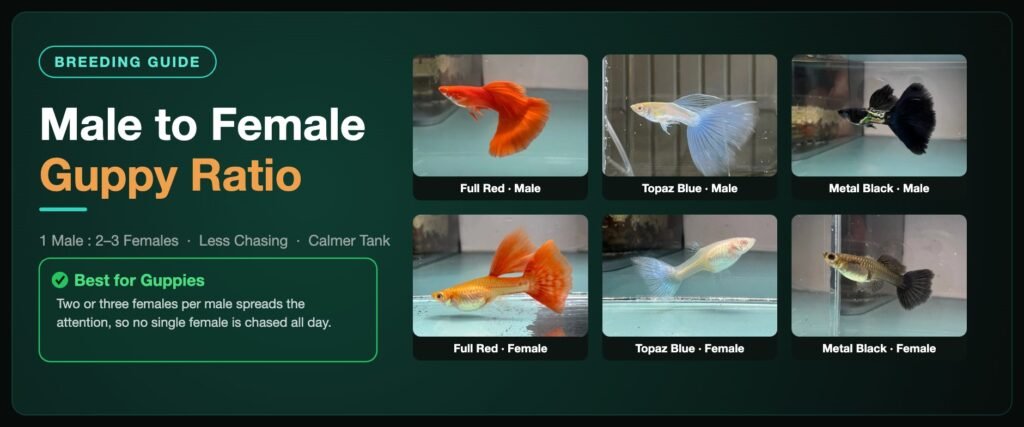

Male guppies court more or less constantly. That is not a flaw, it is how the species works, and it is why the ratio you buy matters more than almost any other stocking decision you will make. Put one male in with one female and she absorbs every bit of that attention all day. Give him two or three females and the same behaviour spreads out into something the whole tank can live with.
The Ratio That Works
- 1 male to 2 females is the minimum that noticeably reduces harassment.
- 1 male to 3 females is the sweet spot for most community and breeding tanks.
- All male works well if you want colour and no fry, with a few conditions below.
- 1 male to 1 female is the one combination to avoid.
If you are buying in small numbers, think in groups of four or six rather than pairs. Two males and six females is a far calmer tank than four of each.
Why the Ratio Matters More Than People Expect
A female being chased all day eats less, hides more and colours down. Over weeks that turns into a thin fish with a weakened immune system, and in a breeding tank it shows up as smaller broods. The male is not being aggressive in the way a cichlid is; he is simply persistent, and persistence with no break is what does the damage.
Male-to-male behaviour is different again. Males display at each other, flare, and occasionally nip fins. In a tank with enough space and a few plants to break sightlines, that stays at the level of posturing. In a bare 20 litre tank it does not.
Ratios by Setup
| Setup | Suggested ratio | Notes |
|---|---|---|
| Community tank | 1 male : 3 females | Calmest option. Expect fry unless you rehome them. |
| Breeding tank | 1 male : 2-3 females | Best control over which male passes on his traits. |
| Show or colour tank | All male | Full finnage and colour, no fry. Needs space and cover. |
| All-female tank | Females only | Often still drops fry for months from earlier matings. |
| Small tank under 40 litres | All male, 4-5 fish | Avoid mixed sexes. Fry will overwhelm the tank fast. |
What Goes Wrong at the Wrong Ratio
- One male, one female: she is pursued from morning to night, stops feeding properly and often dies months early.
- Male-heavy groups: constant displaying, torn tails, and females that never get a quiet moment.
- Too many fish, any ratio: ratio cannot rescue an overstocked tank. Sort stocking first.
If your females are hiding behind the filter, sitting on the substrate, or looking thin despite eating, count your fish before you reach for medication. It is very often just arithmetic.
All-Male Tanks: The Underrated Option
A tank of six or eight males of the same strain is genuinely one of the best-looking setups in the hobby, and there is no fry management at all. Two things make it work. First, keep the group at five or more so no individual becomes the permanent target. Second, give them plants, wood or a spawning mop to break up the open water. Our list of easy live plants for guppy tanks covers the low-effort options.
Add all the males at the same time if you can. Introducing one new male into an established group is where most of the nipping starts.
Sexing Guppies Before You Buy
At retail size the difference is obvious once you know what to look for: males are smaller and slimmer with long, coloured tails and a narrow, pointed anal fin, while females are larger, deeper-bodied, plainer, and have a fan-shaped anal fin plus a dark gravid spot near the vent. Our side-by-side guide to male vs female guppies has the photos if you want to be sure.
One warning worth repeating: a female bought from any mixed tank is very likely already carrying. Guppy females store sperm and can keep producing broods from a single mating for months. An all-female tank is not a fry-free tank, at least not for the first half a year.
Planning for the Fry
At 1:3 in a planted community tank you will get fry, and most will be eaten, which is how the population stays sane. If you actually want to raise them, separate them rather than trying to control numbers by ratio. Our guides to spotting a pregnant guppy and guppy breeding time cover the timing.
Fixing a Tank That Is Already at the Wrong Ratio
You do not need to start again. Work through it in this order:
- Count what you actually have. Net them into a jug if you have to. Most people are surprised by the real split, especially once last season fry have matured.
- Add females rather than removing males where the tank has room. It is cheaper, faster and less disruptive than rehoming.
- If the tank is already full, move the surplus males out into a second tank or rehome them. Two males in a group of eight is plenty.
- Add cover at the same time. Floating plants and a clump of moss give a harassed female somewhere to break line of sight, which helps immediately.
- Give it two weeks. Females that were being chased will start feeding openly again and colour back up. If they do not, look at water quality next.
One caution: do not fix a ratio problem by adding fish to a tank that is already overstocked. A crowded tank at 1:3 is worse than a comfortable tank at 1:2.
Ratio and Lifespan
This is the part people miss. Constant harassment is a chronic stressor, and chronic stress shortens life the same way it does in any animal. Females kept at 1:1 routinely die months earlier than sisters kept at 1:3 on identical food and water. If you are trying to get the full two to three years out of your fish, ratio belongs on the same list as temperature and diet. Our guide to guppy lifespan covers the other factors.
Frequently Asked Questions
What is the best male to female guppy ratio?
One male to three females for most tanks. One to two is acceptable, one to one is not.
Can I keep only male guppies?
Yes, and many keepers prefer it. Keep five or more, add them together, and give them plants or decor to break up open swimming space.
Can I keep only female guppies?
Yes. They are peaceful and get along well. Just expect broods for several months from matings that happened before you bought them.
What happens if I keep one male and one female?
The female gets no rest. She will usually stop feeding properly, lose condition and often dies well short of a normal lifespan. Add two more females or move the male.
Do male guppies fight each other?
They display and occasionally nip, but they do not fight in a damaging way when kept in groups of five or more with adequate space. Trouble tends to start in small bare tanks or when a single new male is added later.
How many guppies should I start with?
Six is a good first group: two males and four females, or six males if you would rather not deal with fry. Our guppy tank mates guide covers how many fish a given tank size will comfortably hold.
Get the ratio right at the point of purchase and most of the drama never happens. You can see our current males and females by strain in the Classic Guppy shop.