
Most pet guppies live far shorter lives than they should — not because they are fragile, but because their tanks swing. Here is what a realistic guppy lifespan looks like by type, how fancy, albino, dumbo ear and wild guppies differ, and what actually adds months at the end of that number.
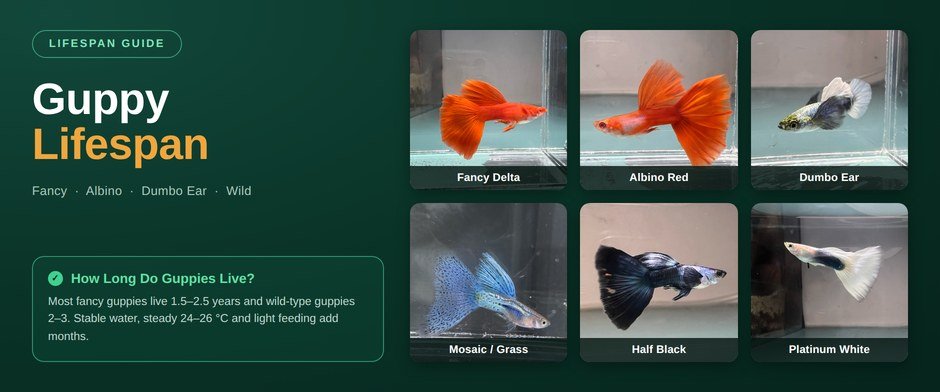
How Long Do Guppies Live? The Short Answer
A healthy home-bred guppy lives 1.5 to 2.5 years. Wild-type and Endler-style guppies often reach 2 to 3 years, and a lightly bred female kept cool and unstressed can pass three. Heavily line-bred show strains sit at the lower end — sometimes 12 to 18 months — because the same selective breeding that produced those huge fins also narrowed the gene pool behind them.
Two guppies from the same drop can differ by a year. Genetics sets the ceiling; your water, temperature and feeding decide how close the fish gets to it.
Guppy Lifespan by Type
| Guppy type | Typical lifespan | What shortens it |
|---|---|---|
| Fancy (delta, veil, ribbon) | 1.5–2.5 years | Fin damage, heavy line-breeding, warm water |
| Albino | 1–2 years | Weak eyesight, light sensitivity, missed meals |
| Dumbo Ear (big ear) | 1.5–2.5 years | Slow swimming, bullying at feeding time |
| Half Black / Moscow | 1.5–2 years | Bulky bodies, appetite for overfeeding |
| Mosaic, Grass, Cobra | 2–2.5 years | Usually hardy; fin rot in dirty water |
| Wild-type & Endler crosses | 2–3 years | Very little — the hardiest group |
| Swordtail-tail & long-fin ribbon | 1–2 years | Trailing fins snag and infect |
Fancy Guppy Lifespan
Fancy guppies are the delta, veil and flag-tail fish most shops sell. Expect 1.5 to 2.5 years. The tail is the weak point: a fin that is a third of the fish’s total mass costs energy to carry, tears on sharp décor and is the first place fin rot takes hold. Keep the flow gentle, skip rough ornaments, and a fancy male will hold his shape well past his second year. If you are choosing between shapes, the guppy tail types guide shows which finnage stays practical.
Albino Guppy Lifespan
Albino guppies are the shortest-lived group in most fishrooms — roughly 1 to 2 years. The red-eye gene comes with genuinely poor vision, so albinos find food slower than their tank mates and quietly fall behind on growth. They also dislike bright, bare tanks. Dim the light, add floating plants, and feed a slow-sinking food twice a day so albinos get their share. Raised that way they close most of the gap on a normal-eyed guppy.
Dumbo Ear Guppy Lifespan
Dumbo ear guppies live about as long as any other fancy — 1.5 to 2.5 years — but their oversized pectoral fins make them slow. In a busy community tank they lose races to the food and get nipped. Keep dumbos with calm tank mates, or in a species tank, and their lifespan matches the rest of the shelf.
Wild Guppy Lifespan
Wild Poecilia reticulata and Endler crosses are the longevity champions of the hobby at 2 to 3 years in an aquarium, sometimes more. Short fins, small bodies and an untouched gene pool mean nothing about them is exaggerated. In the wild rivers of Trinidad most guppies never see a first birthday — predators, not biology, end them — which is why aquarium fish outlive their wild cousins so easily. If you want maximum years and do not mind less finnage, a wild-type or a lightly bred strain from the guppy strain guide is the safest bet.
Male vs Female Guppy Lifespan
Females have the higher ceiling and the lower average. A female that is not constantly pregnant outlives males by several months because she is bigger and less exposed to fin injury. A female that drops a brood every 28 days for two years burns through that advantage and is often spent by 18 months.
Males rarely die of exhaustion; they die of torn fins and stress from chasing. In a mixed tank the classic fix is a ratio of one male to two or three females so no single female is hounded. Anyone breeding seriously should read the guppy breeding care guide and give proven females a rest period between drops.
What Really Sets the Guppy Lifespan
- Temperature. This is the biggest lever you control. At 28–30 °C a guppy grows fast, breeds early and ages fast; at 24–26 °C the same fish matures slower and lives noticeably longer. Set your heater with the ideal guppy tank temperature guide and leave it alone.
- Stable water, not perfect water. Guppies tolerate a wide pH range but hate change. A weekly 25% change with matched temperature beats a heroic 80% change once a month — see how to prepare guppy water.
- Feeding volume. Two small feeds a day, one fasting day a week. Overfed guppies develop fatty liver and constipation long before old age arrives.
- Stocking. Crowding suppresses the immune system. Roughly one adult guppy per litre is a workable ceiling with good filtration.
- Early disease response. Ich, fin rot and columnaris kill in days at tropical temperatures. Catch them with the guppy disease guide while the fish is still eating.
Each of these is covered in depth in our breakdown of the top factors affecting guppy fish lifespan.
How to Tell a Guppy’s Age
Guppies do not go grey, but they do give signals. A young adult male is 3 to 4 months old with full colour — the guppy growth timeline covers that first stretch. From about 18 months you will see the spine begin to curve slightly, colour dull towards the tail base, the fish spend more time resting near plants and, in females, broods drop from 30 fry to a handful. A guppy that stops chasing and starts hovering mid-tank is usually old rather than sick, especially if it is still eating.
Getting the Most Out of Your Guppies
The practical version: buy from a breeder rather than a chain store so you know the line is not inbred, quarantine new fish for two weeks, run the tank at 24–26 °C, change a quarter of the water weekly, feed lightly and keep females off a permanent breeding schedule. Do that and a 2-year guppy lifespan becomes ordinary rather than lucky. The full routine is in the complete guppy care guide.
Frequently Asked Questions
What is the average guppy lifespan in a home aquarium?
About two years. Well-kept fish reach 2.5 to 3 years; guppies in unheated, overstocked or unstable tanks often die inside 12 months.
Do fancy guppies live shorter lives than wild guppies?
Yes, usually by six months to a year. Heavy selection for fin size and colour narrows genetic diversity and adds physical load, while wild-type guppies keep the hardiness that comes with an untouched gene pool.
Why did my guppy die after only a few months?
Almost always the move, not the fish. Shop guppies are shipped young, kept warm and bred hard; dropping them into an uncycled tank with different pH and temperature causes losses in the first four to eight weeks. Cycle the tank first and acclimatise slowly.
Does temperature change how long guppies live?
Significantly. Guppies kept at 28–30 °C run a faster metabolism, mature earlier and age earlier. A steady 24–26 °C is the sweet spot for longevity without slowing growth to a crawl.
How long do albino and dumbo ear guppies live?
Albinos average 1 to 2 years because poor eyesight costs them food and they stress in bright tanks. Dumbo ear guppies match normal fancies at 1.5 to 2.5 years provided they are not outcompeted at feeding time.
Do female guppies live longer than males?
They can, if they are not breeding continuously. Non-stop pregnancies from four months old wear a female out by around 18 months, while a rested female often reaches three years.