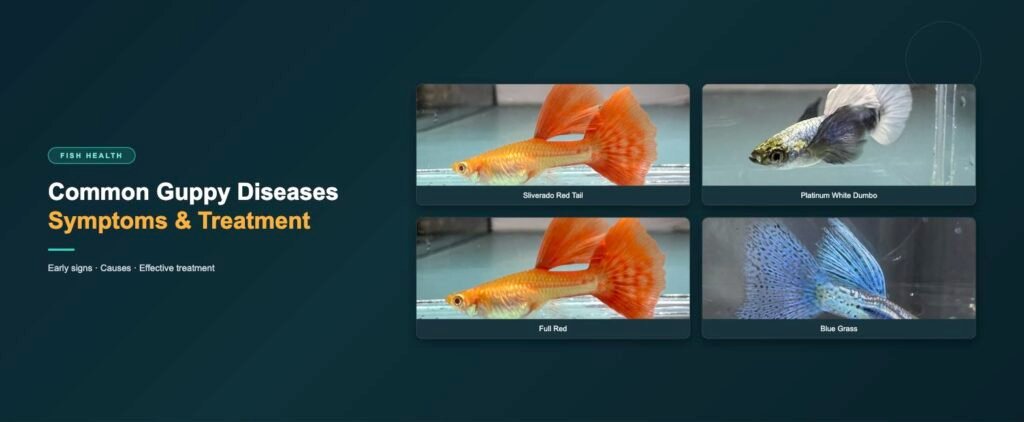
Even in a well-run tank, guppies occasionally get sick, and knowing what a particular disease looks like — and how to respond quickly — often decides whether a fish recovers or the whole tank suffers an outbreak. Most guppy diseases share warning signs like clamped fins, loss of appetite, or unusual spots, so learning to tell them apart is the first real skill in fishkeeping. Below are the most common guppy diseases, their symptoms, likely causes, and the treatment approach that works best for each, so you can react with confidence instead of guessing.
Quick Takeaways
- Fin rot: ragged, disintegrating fins, usually from poor water quality.
- Ich: tiny white salt-like spots, highly contagious and needs prompt treatment.
- Dropsy: swollen body and raised scales, often a sign of serious internal illness.
- Columnaris: white or grey cottony patches, usually bacterial and fast-moving.
- Velvet: a fine gold or rust dust coating the body, sensitive to light.
- Prevention beats treatment: stable water and quarantine stop most outbreaks before they start.
Fin Rot
Fin rot shows up as ragged, fraying, or disintegrating fin edges, sometimes with a white or red tinge along the damaged area, and is usually caused by prolonged poor water quality or a physical injury that becomes infected. Mild cases often improve simply with a large water change and a scrupulously clean tank for the following week. More advanced cases respond well to an antibacterial treatment such as API Fin & Body Cure or Seachem KanaPlex, dosed according to the label. Left untreated, fin rot can progress toward the fish’s body, so early action gives the best chance of a full recovery.
Ich (White Spot Disease)
Ich appears as tiny white spots resembling grains of salt scattered across the body and fins, often paired with fish scratching themselves against decorations or gravel. It is caused by a parasite and spreads extremely quickly between tankmates, so the whole tank needs treatment, not just the visibly affected fish. Raising the temperature slightly to around 28–29°C speeds up the parasite’s life cycle so medication works faster, and a dedicated treatment such as API Super Ick Cure or Ich-X by Hikari clears most cases within a week to ten days when dosed for the full recommended course.
Dropsy
Dropsy isn’t a single disease but a symptom of serious internal illness, recognisable by a swollen, bloated body and scales that stick outward like a pinecone. By the time these signs appear, the underlying infection is usually advanced, so recovery odds are lower than with fin rot or ich. Isolating the fish, keeping water pristine, and trying a broad-spectrum antibacterial such as Seachem KanaPlex gives the best chance, but most keepers focus on preventing dropsy through excellent water quality rather than expecting to reliably cure it once symptoms appear.
Columnaris (Cotton Wool Disease)
Columnaris causes white or greyish, cotton-like patches on the mouth, fins, or body, and can move through a tank fast because it is bacterial and highly contagious. It is often triggered by stress from overcrowding, poor water quality, or a recent injury. Treatment usually combines an antibacterial medication such as Maracyn or Furan-2 with an immediate water change and improved filtration, since the bacteria thrive in dirty conditions. Because columnaris can kill within days once advanced, treating at the very first white patch gives noticeably better results than waiting.
Velvet Disease
Velvet coats the body in a fine, gold or rust-coloured dust that’s easiest to spot by shining a flashlight across the fish in a darkened room. Affected guppies often clamp their fins, breathe rapidly, and rub against objects in the tank. Because the parasite responsible is sensitive to light, dimming the tank during treatment helps, alongside a copper-based or formalin medication such as API General Cure. As with ich, velvet spreads fast, so treat the entire tank rather than isolating a single fish.
Swim Bladder Disorder
Guppies with a swim bladder problem float sideways, sink to the bottom, or struggle to swim upright, which is usually caused by overfeeding, constipation, or a bacterial infection rather than a parasite. Skipping food for a day or two, then offering a small piece of blanched, skinned pea, often resolves mild cases caused by digestion issues within a few days. If the problem persists, treat the water for a possible underlying infection and keep the tank warm and clean while the fish recovers.
Preventing Disease Before It Starts
Most guppy diseases trace back to the same root causes: unstable or dirty water, overcrowding, and introducing new fish without quarantine. A simple two-week quarantine tank for new arrivals, weekly partial water changes, and avoiding overstocking prevent the majority of outbreaks before they ever begin. Keeping a basic medicine cabinet on hand — a general cure, an antibacterial treatment, and aquarium salt — means you can react within hours rather than days if something does appear.
Recognising these conditions early, and responding with the right treatment rather than guessing, turns most guppy diseases from a tank-wide emergency into a manageable, short-term setback.