Eight hardy, low-light live plants that thrive in a simple guppy tank, give fry somewhere to hide, and need almost no maintenance — no CO2 kit required.
Why Live Plants Are Worth It
Live plants absorb nitrate, add oxygen, and give fry somewhere to hide from adult guppies. The species below all tolerate the moderate light and simple, no-CO2 setup that most guppy keepers already run.
There is a second benefit that matters more in a guppy tank than most: plants stabilise water chemistry. A well-planted tank swings less between water changes, and steadier parameters mean less stress, better colour and stronger fry. Plants also give shy or newly added guppies somewhere to retreat, which reduces the nipping that can happen in a bare, open tank.
Java Fern
Java Fern attaches to driftwood or rock rather than being planted in substrate, which makes it almost impossible to uproot. It tolerates low light and irregular dosing, and slowly produces new plantlets along its leaf edges that you can trim off and replant.
It grows slowly, so give it a few months before judging it. Older leaves sometimes develop black spots and holes, usually a sign of low nutrients rather than disease; a monthly dose of all-in-one liquid fertiliser normally clears it up.
Anubias
Anubias grows slowly, needs very little light, and is one of the few plants guppies will never nibble on. Like Java Fern, its rhizome should sit above the substrate rather than buried, or it can rot.
Attach the rhizome to wood or rock with thread or a dab of gel superglue, and never bury it in substrate — a buried rhizome rots. Anubias is also tough enough to survive tanks where fast plants melt, which makes it a reliable anchor plant while you are still learning.
Guppy Grass
Guppy Grass is a fast-growing floating or loosely rooted stem plant that fry use as cover, and it’s one of the few plants that pulls nitrate out of the water quickly enough to notice. It needs no fertilizer or CO2 and can simply be trimmed and thinned when it grows too thick.
Because it grows so fast, Guppy Grass doubles as a nutrient sponge — useful in a breeding tank where you feed heavily and nitrate climbs quickly. Simply pull out handfuls when it gets too thick; it needs no trimming technique beyond that.
Java Moss
Java Moss can be tied to decor or left to drift and forms a dense mat that fry love to hide in during their first few weeks. It grows in almost any light level and only needs an occasional trim to keep it tidy.
Moss is also where infusoria and micro-organisms collect, which is effectively free first food for newborn fry. Trim it back with scissors when it gets shaggy, since the inner layers brown off once light stops reaching them.
Four More Easy Plants Worth Adding
The four species above are the safest starting point, but a guppy tank benefits from a mix of growth habits — something rooted, something stemmy and something floating. These four are just as forgiving and cover the gaps.
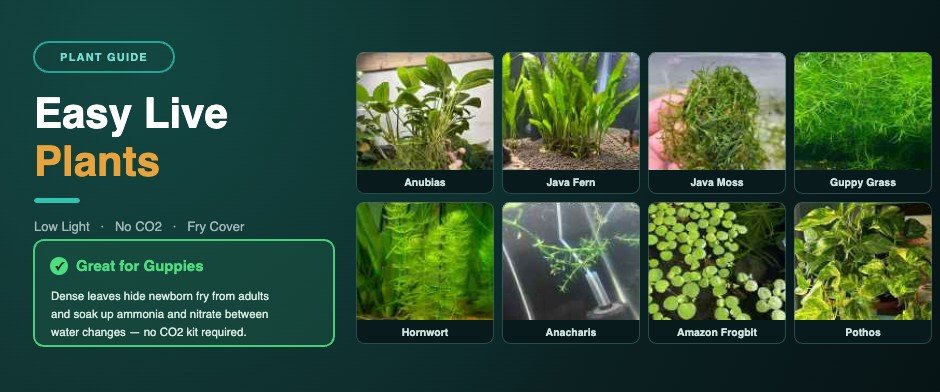
Hornwort is the fastest nutrient sponge on this list. It has no true roots, so you can float it, weigh it down, or wedge it behind a filter, and it will keep growing either way. That speed is exactly what makes it useful in a guppy tank: fast growth means heavy nitrate uptake, which directly competes with algae. Its needle-fine foliage also forms superb fry cover. It does shed needles when moved or when lighting changes suddenly, so expect to net out debris for a week after rearranging it.
Anacharis, sold as Elodea in some shops, is a classic beginner stem plant that grows in almost anything. Plant a few stems in substrate or let them float, and trim the tops to replant whenever they get leggy — each cutting becomes a new plant. It prefers cooler, harder water, which suits guppies well. Like Hornwort, it is a strong nitrate consumer and helps hold algae down in a newly set-up tank.
Amazon Frogbit is a floating plant with round leaves and long trailing roots. Those roots are the point: they dangle into the water column and give newborn fry a dense curtain to disappear into near the surface, exactly where they naturally stay. Frogbit also shades the tank, which suppresses algae, and draws its CO2 from the air rather than the water, so it grows quickly with no dosing. Thin it whenever it covers more than about half the surface, or your rooted plants below will start to struggle for light.
Pothos is the odd one out — it is a houseplant, not an aquatic plant. You grow it with the roots in the water and the leaves outside the tank, usually draped over the back rim or from a hang-on-back filter. Because the leaves are in open air, it grows fast and pulls nitrate out of the water at a rate few submerged plants match, making it a favourite trick in heavily stocked guppy and breeding tanks. Only the roots should be submerged; leaves left underwater will rot.
Planting Tips for Guppy Tanks
A few habits keep a planted guppy tank looking good without turning it into a second hobby.
- Leave floating cover like Guppy Grass in at least one corner if you’re raising fry.
- Attach rhizome plants, such as Java Fern and Anubias, to hardscape instead of burying them.
- A light once-a-week trim keeps fast growers like Guppy Grass from shading out the rest of the tank.
- Thin floating plants like Frogbit once they shade more than half the surface, or rooted plants below will suffer.
Frequently Asked Questions
Do I need CO2 for a guppy tank?
No. Every plant on this list grows well without added CO2 under normal aquarium lighting. Hornwort, Anacharis and Guppy Grass are the fastest growers of the group, and Pothos draws its CO2 straight from the air.
Will guppies eat my plants?
Guppies mainly graze on the biofilm and algae that form on leaves rather than eating the plant itself, so live plants are generally safe. The one exception is soft new growth on stem plants, which adults occasionally nibble — it rarely does lasting damage.
What’s the best plant for guppy fry to hide in?
Guppy Grass and Java Moss are the top picks. Both form dense cover near the surface or substrate where fry can escape adult guppies.
How many plants does a guppy tank need?
There is no fixed number, but aim to cover roughly a third of the tank once the plants fill in. That is enough cover for fry and enough leaf surface to make a real dent in nitrate, while still leaving open water for adults to display and swim.
Can I keep live plants with a bare-bottom guppy tank?
Yes. Java Fern, Anubias and Java Moss attach to hardscape rather than substrate, and Hornwort, Guppy Grass and Amazon Frogbit all float, so none of them need anything to root into.