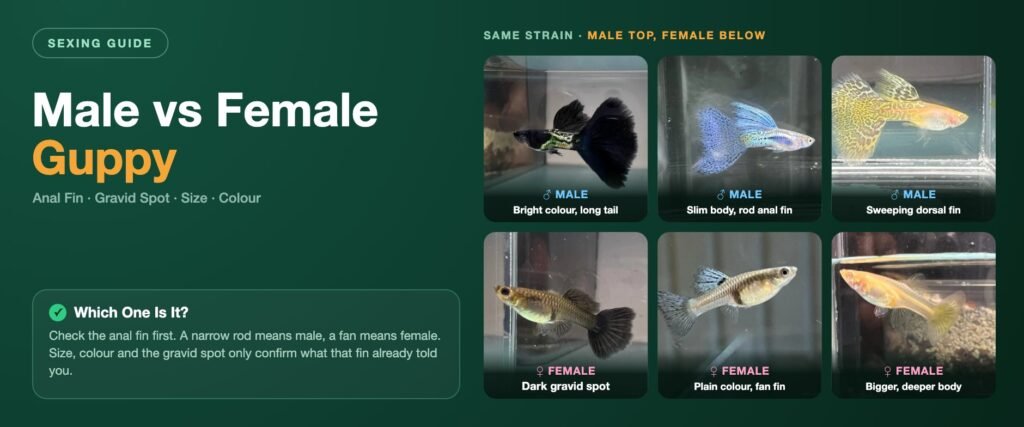

Telling a male vs female guppy apart takes about three seconds once you know where to look, and getting it wrong costs you a tank full of unplanned fry. Colour is the sign most people reach for first, and it is the least reliable one — plenty of modern strains put colour on their females too. The anal fin never lies. Here are the six differences in order of how much you can trust them, plus how early you can sex fry and the mix-ups that catch everyone out.
Male vs Female Guppy at a Glance
| Feature | Male | Female | How reliable |
|---|---|---|---|
| Anal fin | Narrow, pointed rod (the gonopodium) | Wide, triangular fan | Always right |
| Gravid spot | None | Dark patch in front of the tail | Always right on adults |
| Adult size | 3–4 cm body | 5–6 cm body | Reliable after 3 months |
| Body shape | Slim, streamlined | Deep, rounded belly | Reliable after 3 months |
| Colour | Bright, heavy patterning | Plainer, often silver or olive | Unreliable in fancy strains |
| Dorsal fin and tail | Long, sweeping, wide tail | Shorter fins, smaller tail | Unreliable in short-finned strains |
| Behaviour | Constantly courting and chasing | Being chased; feeds steadily | Good supporting sign |
The Gonopodium: The One Sign That Never Lies
Look at the fin on the underside of the fish, roughly halfway between the belly and the tail. On a female it is a small fan, shaped like every other fin. On a male the same fin has rolled into a narrow, stiff rod that points backwards — the gonopodium, which he uses to fertilise the female. It is present on every male of every strain, colourful or plain, long-finned or short, and it never appears on a female. The species profile for Poecilia reticulata describes the same structure in the wild fish.
View the fish from the side against a light background, or photograph it and zoom in. If the anal fin looks like a stick, it is a male. If it looks like a triangle, it is a female.
Sexing Guppy Fry: How Early Can You Tell?
| Age | What is visible | Can you sex them? |
|---|---|---|
| 0–2 weeks | Translucent bodies, identical fins | No |
| 3–4 weeks | Anal fin starts narrowing on males; faint gravid spot on females | Sometimes, in good light |
| 4–5 weeks | Gonopodium clearly forming; colour begins on males | Yes — separate now |
| 6–8 weeks | Males fully coloured and fertile | Obvious |
| 10–12 weeks | Females noticeably larger and deeper | Obvious |
Four to five weeks is the window that matters. Males can fertilise females from around six weeks, so a mixed grow-out tank left alone until “they look old enough” is already breeding. If you are keeping a line pure, split the sexes as soon as the gonopodium appears and raise virgin females — the reasoning is in how to choose a female guppy for a superior strain. For what your fry should look like at each stage, compare against the guppy growth timeline.
Four Mix-Ups That Catch Everyone Out
- A colourful female. Albino, koi and full-red strains often carry strong colour on the tail of the female too. Colour tells you the strain, not the sex.
- A young male mistaken for a female. Before five weeks he has no colour and no rod yet. Wait, do not guess.
- A short-finned male. Not every male has a sweeping tail; wild-type and some line-bred males are plain. The anal fin still gives him away.
- A “fat male”. Males do not develop a gravid spot or a deep belly. A swollen male is an ill male — check the guppy disease guide.
How Many of Each Should You Keep?
Once you can separate a male vs female guppy on sight, the next decision is the ratio. Get it wrong and the females pay for it: constant chasing keeps them off food and shortens their lives.
| Setup | Ratio | What to expect |
|---|---|---|
| All-male tank | Males only | Maximum colour, zero fry; occasional harmless sparring |
| All-female tank | Females only | Calm and plain — but expect fry anyway from stored sperm |
| Breeding group | 1 male : 2–3 females | Steady broods; no single female is chased all day |
| Mixed community | Never 1:1 | A lone female is harassed constantly and stops feeding |
An all-male tank is the standard answer for keepers who want the colour without a population explosion. If you do want broods, pair them properly — how to choose the perfect guppy breeding pair covers selection, and guppy tank mates has the stocking numbers for each tank size.
How Males and Females Behave Differently
Sexing is not only about anatomy. Watch the tank for two minutes and the male vs female guppy split shows up in behaviour as clearly as it does in the anal fin.
Males spend most of the day courting. They dart in front of females, curve their bodies into an S-shape, flick the dorsal fin open and follow relentlessly. They also spar with each other, flaring fins side by side without ever doing real damage. That constant activity is why males burn out faster and generally live a few months less than females — the reasons are covered in the factors affecting guppy lifespan.
Females behave in the opposite way. They feed steadily, hold position in the mid-water, and move away from pursuing males. A female that suddenly hides in the plants, stops eating and sits near the heater is either about to give birth or is being harassed by too many males. Both problems have the same fix: more females, fewer males, and more planted cover.
One more practical difference. Because males are smaller and thinner, they need slightly more frequent feeding to hold condition, while females tolerate a missed meal far better. If you keep an all-male display tank, feed small amounts twice a day rather than one large meal.
Frequently Asked Questions
What is the easiest way to tell a male vs female guppy?
The anal fin. A narrow rod pointing backwards means male; a wide triangular fan means female. It works on every strain at every age past four weeks.
Are female guppies always bigger?
As adults, yes — typically 5–6 cm against 3–4 cm for a male, and much deeper in the body. Below three months the difference is not reliable.
Can female guppies be colourful?
Yes. Many fancy strains carry colour on the female’s tail. Never sex a guppy on colour alone.
Can a guppy change sex?
No. What people see is a late-developing male whose gonopodium and colour arrive after the females in the batch have already matured.
Do I need males at all?
Only for breeding. Females live perfectly well without them, and without a male they are far less stressed.
At what age can guppies breed?
Males from about six weeks, females from ten to twelve weeks. See guppy breeding time for the full breeding-age chart.
Check the anal fin, confirm with the gravid spot and body depth, and ignore colour completely. Do that and the male vs female guppy question stops being a guess — and your grow-out tanks stop producing surprises.