
Not every attractive guppy makes a good breeder. Choosing a breeding pair — or more accurately, a small breeding group — well is what actually determines whether your fry grow up healthy, colourful, and true to the strain you’re aiming for. It comes down to more than picking the two prettiest fish in the tank: health, body shape, bloodline, and even behaviour all play a role. Here’s what to actually look for before you set up a breeding tank.
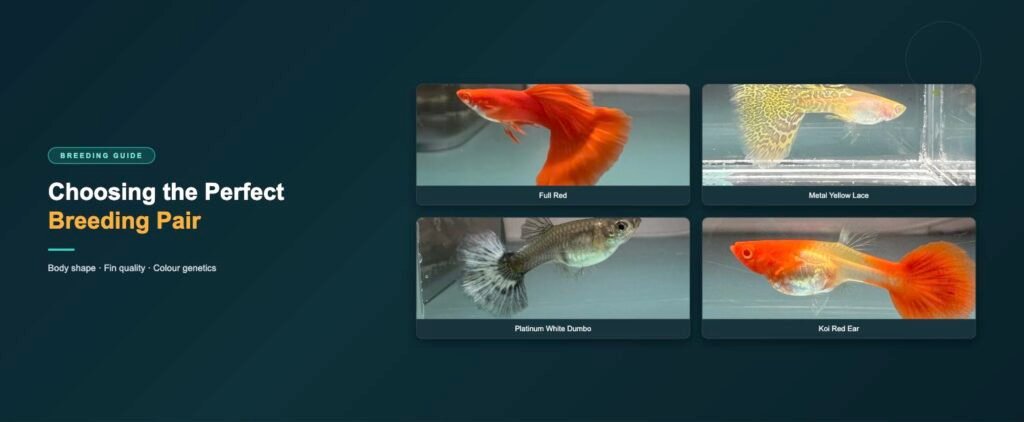
Quick Takeaways
- Health first: active, alert fish with no visible deformities make the safest breeders.
- Straight spine, full fins: body shape and fin quality are highly heritable traits.
- Match strains carefully: crossing very different strains gives unpredictable, muddy-coloured fry.
- Avoid close relatives: repeated inbreeding weakens colour, size, and immunity over generations.
- Pick fully mature adults: very young or very old guppies breed less reliably.
- Keep more females than males: a 2:1 or 3:1 ratio reduces stress on females.
Start with Health, Not Just Colour
It’s tempting to choose breeders purely on colour, but a stunning fish with a weak immune system or poor genetics will often pass those weaknesses on to its fry. Look for guppies that are active, alert, and feeding well, with clear eyes, full fins, and no signs of clamped fins, unusual thinness, or laboured breathing. A guppy that has stayed healthy for several weeks in your tank is a safer breeding choice than a striking specimen you just brought home, since you have already seen it handle your specific water conditions well.
Check Body Shape and Fin Quality
Body shape and fin quality are strongly heritable, so a breeder with a curved spine, pinched body, or asymmetrical fins is likely to pass those same flaws on to at least some of its fry. Look for a straight spine, a smoothly tapered body, and full, evenly shaped fins without holes, splits, or ragged edges from old injuries. These structural traits matter just as much as colour if your goal is to raise consistently healthy-looking guppies generation after generation.
Match Strains for Predictable Fry
If you’re aiming for a specific look — say, a solid red or a particular tail pattern — breeding two guppies from the same or a closely related strain gives far more predictable results than crossing two very different-looking fish. Crossing unrelated strains often produces fry with muddled, less impressive colouring in the first generation or two, since guppy colour genetics can take several generations to stabilise into a new consistent look. If predictable colour matters to you, keep your breeding stock within the same strain line.
Avoid Inbreeding: Check the Bloodline
Breeding closely related guppies repeatedly — siblings, or parent to offspring — gradually shrinks the gene pool and can lead to smaller fry, weaker immune systems, and more frequent deformities over several generations. Where possible, introduce occasional new, unrelated stock of the same strain every few generations to keep the bloodline healthy, or trade fry with another keeper breeding the same variety. A little planning here pays off far more in fry quality than most people expect.
Age and Size Matter Too
Very young females can breed but often produce smaller, less robust first broods, while very old guppies of either sex tend to have reduced fertility and weaker fry. Aim for breeders around four to eight months old, fully grown, and at a healthy weight — neither skinny nor visibly overfed — for the most reliable results.
Male-to-Female Ratio for Breeding Groups
A single dedicated pair works, but most breeders get better long-term results from a small group with two to three females per male, since a lone female can be harassed constantly by an eager male. This ratio spreads out mating attention, reduces stress-related health issues in the females, and still gives you plenty of fry to select your next generation of breeders from.
Watch Behaviour Before You Commit
Spend a few days simply observing candidate breeders before moving them into a dedicated tank. Confident, active fish that eat readily and interact normally with tankmates make more reliable breeders than skittish or constantly hiding fish, which may be dealing with stress, illness, or bullying that isn’t obvious at a glance.
A great breeding pair — or small breeding group — comes down to health, structure, and a bit of planning around strain and bloodline. Get those right, and colour will follow naturally over the next few generations.