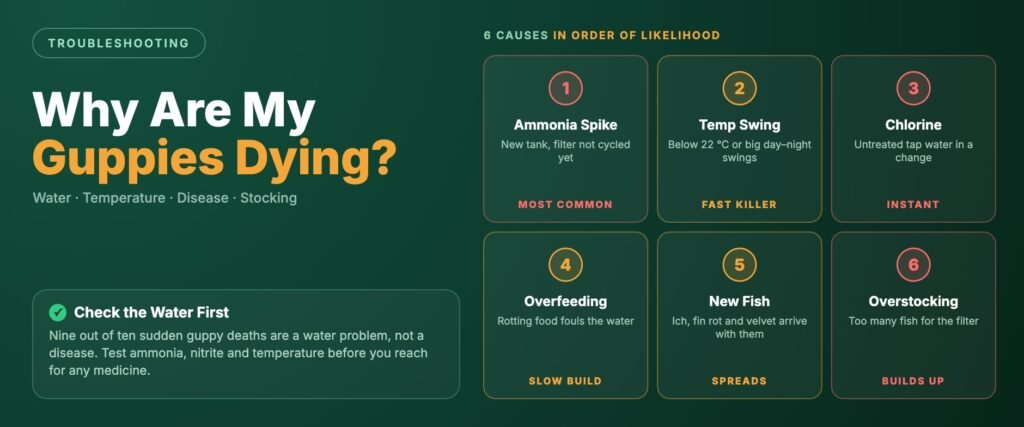
Guppies dying one after another almost never means you bought weak fish. In a healthy, stable tank a guppy lives 1.5 to 2.5 years; when they start dropping in days or weeks, something measurable has changed in the water. This guide works through the causes in the order they actually happen, tells you which signs point to which problem, and gives you the fix for each one.
Check These Three Things Before Anything Else
- Ammonia and nitrite. Both must read 0 ppm. Any reading at all is enough to kill. This is the single most common reason for guppies dying in a tank under two months old.
- Temperature. It should sit between 24 and 27 °C and move less than 1 °C across the day. Put a thermometer at the far end from the heater, not next to it.
- What went into the last water change. Untreated tap water kills through chlorine or chloramine within hours, and cold top-ups shock fish just as fast.
Buy a liquid test kit rather than strips — strips read high and vague, and that is exactly the wrong direction when you are trying to rule ammonia in or out. If you have no kit at all, do a 30% water change with dechlorinated, temperature-matched water right now; it costs nothing and fixes the most likely cause. The method is in how to prepare guppy fish water.
10 Reasons Guppies Die — and the Fix for Each
| Cause | What you see | The fix |
|---|---|---|
| Uncycled tank (ammonia or nitrite) | Gasping at the surface, red or ragged gills, deaths within days of setup | Daily 30–50% water changes until both read 0; cycle the filter properly |
| Chlorine or chloramine | Whole tank affected hours after a water change; erratic swimming | Always use a dechlorinator; never refill straight from the tap |
| Temperature swings | Clamped fins, lethargy, deaths after cold nights | A heater sized to the tank, plus a thermometer away from it |
| Overfeeding | Cloudy water, food on the substrate, bloated fish | Feed what is eaten in 30 seconds, twice a day; siphon leftovers |
| Nitrate build-up | Slow decline over weeks, faded colour, stillborn fry | 25% weekly water change; keep nitrate under 20 ppm |
| Overstocking | Gasping in the evening, aggression, filter cannot keep up | Rehome or upgrade the filter; see the stocking chart below |
| Disease from new fish | White spots, cotton patches, rotting fins, flicking on decor | Quarantine every new fish for two weeks; treat the specific disease |
| Wrong water chemistry | New fish die in days while old ones are fine | Guppies want pH 7.0–7.8 and moderately hard water; acclimate slowly |
| Old age or line-bred weakness | Only the oldest fish die; the rest are fine | Nothing to fix — buy from lines bred for vigour, not just colour |
| Shipping and transfer stress | Deaths in the first 3–7 days after buying | Drip-acclimate over 45 minutes; keep the lights off for a day |
Ammonia and nitrite are the two links in the nitrogen cycle that your filter bacteria have not yet learned to handle in a new tank. Until they have, the tank is not a home; it is a countdown.
Sudden Deaths vs a Slow Decline
| Pattern | Most likely cause |
|---|---|
| Several fish die within hours | Chlorine, a temperature crash, or a poisoned tank (aerosol, soap, untreated water) |
| One or two a day for a week | Ammonia or nitrite in a cycling tank |
| Only the new fish die | Acclimation shock or a disease they arrived with |
| Only males die | Exhaustion from constant courting, or fin damage turning into fin rot |
| Only pregnant females die | Stress, a cramped breeding box, or nitrate |
| Slow fade over a month | Nitrate build-up, overfeeding, or an unheated tank |
Match the pattern before you medicate. Dosing a healthy tank for a disease it does not have kills the filter bacteria and turns a water problem into a much bigger one — the guppy medicine list explains what each treatment actually does.
New Guppies Dying in the First Week
New guppies dying while your established fish stay healthy is its own problem. A guppy that has been bagged, driven home and tipped into different water has had three shocks in one day. Float the sealed bag for 20 minutes to match temperature, then drip tank water in over 30 to 45 minutes so pH and hardness change gradually. Do not add the shop water to your tank. Keep the lights off for the first day and do not feed until the next morning.
Quarantine matters just as much. Two weeks in a separate heated container with a sponge filter stops one sick fish from taking out an established tank, and it gives you a place to treat problems cheaply. Most outbreaks covered in the guppy disease guide arrive this way.
Emergency Checklist
If you have guppies dying right now and no test kit in the house, work through this in order. It is written so that every step is safe even when you do not yet know the cause.
- Test ammonia, nitrite, nitrate and temperature. Write the numbers down.
- Do a 30% water change with dechlorinated water at the same temperature.
- Stop feeding for 24 hours and siphon any waste from the substrate.
- Check the filter is actually flowing and has not been rinsed in tap water.
- Add an air stone — warm, dirty water holds less oxygen.
- Move visibly sick fish to a quarantine container before treating anything.
- Change nothing else for 48 hours, then retest and compare.
If the filter is undersized for the stock, that is the root cause and no amount of water changing fixes it permanently — compare options in the guppy filter guide, and check your numbers against the stocking chart in guppy tank mates.
Frequently Asked Questions
Why are my guppies dying one by one?
A steady trickle of deaths over days almost always means ammonia or nitrite in a tank whose filter has not finished cycling. Test first, then do daily partial water changes.
Why did all my guppies die overnight?
Sudden whole-tank losses point to chlorine in fresh tap water, a heater failure, or something toxic entering the tank — insecticide, cleaning spray or soap on hands.
Can guppies die from a water change?
Yes, if the new water is untreated, colder or warmer by more than a degree or two, or if you replace more than half the tank at once.
My guppy is at the bottom of the tank — is it dying?
Sitting on the bottom with clamped fins means stress, cold or poor water. A pregnant female resting near the heater is normal; a fish that will not swim when disturbed is not.
Do guppies die easily?
No. They are hardy in stable water and fragile in swinging water. Most losses are a cycling or temperature problem, not a delicate fish.
How long should I wait before adding replacements?
Two clear weeks with zero ammonia, zero nitrite and no further deaths. Adding fish into an unresolved problem simply repeats it.
Test before you treat, change water before you medicate, and quarantine before you introduce. Do those three and guppies dying stops being a mystery you keep paying for — the routine that prevents it is in the complete guppy care guide.
If it is fry rather than adults you are losing, the causes are different again – see why guppy fry keep dying.
If the die-off is limited to fry rather than adults, the causes are different — see our guide to fry-specific mortality. Heating and water-movement problems are also common triggers; our heater and equipment guide covers what’s actually necessary. Once your tank is stable, browse our home-bred strains to restock with healthy, hardy fish.