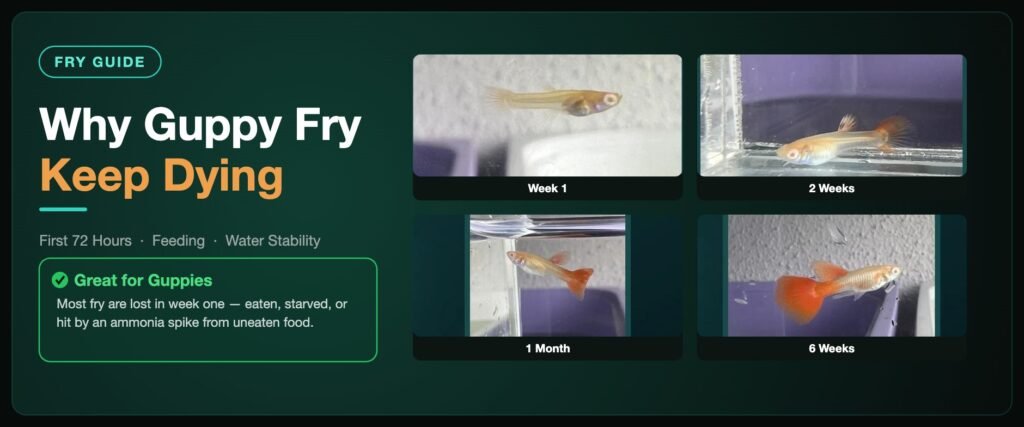
A guppy drops thirty fry and a week later there are six. It is one of the most common and most frustrating things that happens to new breeders, and it almost never means you bought weak fish. Guppy fry are not delicate, but they are small, and small means they hit trouble faster than adults do. Almost every loss traces back to one of eight causes, and most of them happen in the first seven days.
Check These Three Things First
- Are they dying, or disappearing? Bodies on the substrate mean a water or food problem. No bodies at all almost always means something ate them.
- Test ammonia and nitrite. In a small, freshly set up fry tank these can climb from zero to dangerous in two days.
- Check the temperature at fry level, not on the room thermostat. A breeding box hanging near the surface can sit a degree or two off the main tank.
Those three answers narrow it down immediately.
8 Reasons Guppy Fry Die, and the Fix for Each
| Cause | What you see | The fix |
|---|---|---|
| Eaten by adults | Fry vanish with no bodies, numbers drop fastest in the first 48 hours | Move fry to their own tank, or plant heavily with moss and floating plants so they have cover |
| Ammonia or nitrite spike | Fry gasping at the surface, sitting on the bottom, dying in batches | Test immediately, 25% water change with temperature-matched water, add mature filter media |
| Starvation | Fry stall in size, look thin from above, die gradually over two weeks | 4-5 tiny feeds a day, every day. Fry cannot go a day without food |
| Overfeeding | Cloudy water, film on the surface, deaths a few days after a heavy feed | Feed less per meal but more often, and siphon the bottom daily |
| Temperature swings | Deaths overnight or after water changes, fry clamped and still | Keep 25-27 C and stable. Match new water to within 1 C |
| Filter intake | Fry disappear one or two at a time in a tank with no adults | Switch to a sponge filter, or cover the intake with a sponge pre-filter |
| Water change shock | Healthy fry die within hours of a water change | Change less, more often. Add new water slowly, never straight from the tap |
| Weak genetics | Bent spines, fry that never grow, consistent losses across every brood | Bring in unrelated stock. Repeated sibling pairings show up in the third or fourth generation |
The First 72 Hours Decide Most of It
Newborn fry still have a little yolk reserve and spend the first day or so hiding rather than swimming openly. This is when they are most likely to be eaten and least likely to find food. Give them somewhere to hide and something tiny to eat and survival rates jump.
Practical version: a clump of java moss, a handful of floating plants, and the first feed within twelve hours of birth. That is most of the battle.
Disappearing Is Not the Same as Dying
This distinction saves a lot of wasted medication. If you never find bodies, nothing is sick. Guppies eat their own fry readily, and so does every other fish in a community tank. A single adult can clear a brood in a day in an open tank.
If you are finding bodies, the tank is telling you something about water, temperature or food, and the table above is where to start. Our guide to why guppies die covers the same logic for adults.
Breeding Box or Separate Tank?
| Breeding box | Separate fry tank | |
|---|---|---|
| Cost | Very low | Higher, needs a second heater and filter |
| Water quality | Shares the main tank, but cramped and low flow | Full volume, easier to keep stable |
| Stress on the mother | High if she is left in for days | Low, she goes back after dropping |
| Fry growth | Slower, space limits it | Noticeably faster |
| Best for | Catching a brood you did not plan for | Anyone breeding on purpose |
If you use a box, move the female in only when she is clearly close, and take her out as soon as she has dropped. Leaving a female in a small box for days is a common cause of losing both the mother and the brood. Our guide to pregnant guppy signs and stages covers how to time it.
If Fry Are Dying Right Now
- Test ammonia and nitrite. Anything above zero, do a 25% water change with temperature-matched, dechlorinated water.
- Check the thermometer at fry level and stabilise at 25-27 C.
- Siphon any uneaten food and waste off the bottom with airline tubing.
- Stop feeding for the rest of the day if the water is cloudy, then restart with much smaller portions.
- Move any adults out, or move the fry out.
- Add a sponge filter if you are running anything with an open intake.
- Do not medicate. Almost nothing that kills fry in week one is an infection.
Frequently Asked Questions
Why are my guppy fry dying one by one?
A slow trickle of losses usually means food or water quality rather than predation. Test ammonia and nitrite first, then look at whether they are being fed often enough.
Why did all my guppy fry die overnight?
An overnight wipeout points to a sudden change: a temperature drop, a water change with unmatched water, or an ammonia spike after a heavy feed. Oxygen also falls to its lowest just before dawn.
How many guppy fry usually survive?
In a planted community tank with adults, often only a handful out of thirty. In a dedicated fry tank with good feeding, 80 to 90 per cent is realistic.
Do guppy fry need light at night?
No. They need a normal day and night cycle. Leaving the light on around the clock stresses them and does not speed up growth.
When can fry go in with adults?
Once they are too big to fit in an adult mouth, usually around six to eight weeks. Our guppy growth timeline shows what to expect at each stage.
Should I separate the mother before she gives birth?
Only shortly before. Moving a heavily pregnant female too early, or keeping her confined for days, causes stress that can lead to premature or stillborn fry.
Sort the water, sort the feeding, and give them somewhere to hide. Do those three and most broods come through nearly intact. If you want to start from strong stock, our home-bred strains are listed in the Classic Guppy shop.