A guppy water change is the cheapest piece of fish keeping there is, and the one most people either skip or overdo. Change too little and nitrate creeps up until colours fade and fry are born dead. Change too much at once and you strip the tank of the bacteria and stability the fish depend on. This is the schedule that works, by tank type, with the exact method and the mistakes that kill fish.
How Often Should You Change Guppy Water?
| Tank | How often | How much | Why |
|---|---|---|---|
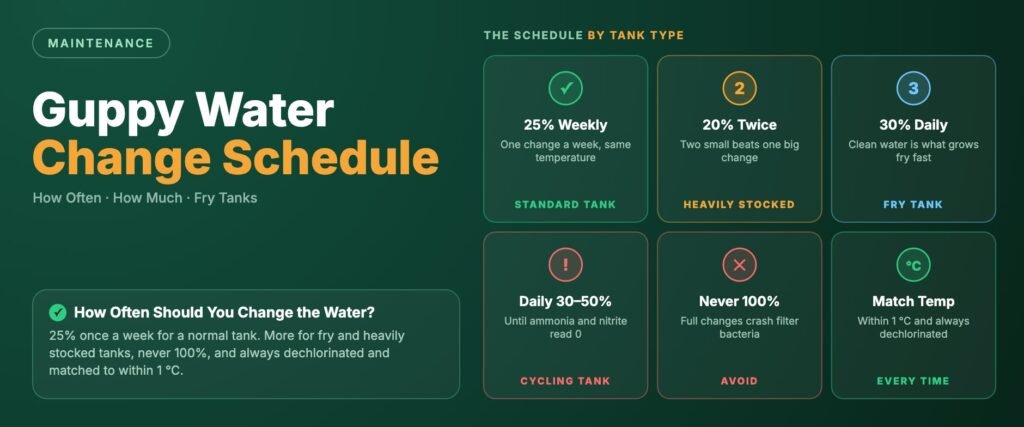
| Established community tank | Once a week | 25% | Keeps nitrate under 20 ppm without disturbing the fish |
| Heavily stocked tank | Twice a week | 20% each time | Two small changes are gentler than one large one |
| Fry or grow-out tank | Daily or alternate days | 30% | Clean water is the single biggest driver of fry growth |
| New, cycling tank | Daily | 30–50% | Dilutes ammonia and nitrite until the filter catches up |
| Breeding or birthing tank | Twice a week | 20% | Stable water; never on the day she is due |
| Quarantine or hospital tank | Daily | 25% | Removes waste and refreshes any medication dose |
| Heavily planted, lightly stocked | Every 10–14 days | 20% | Plants export some nitrate themselves |
If you only remember one line: 25% weekly for a normal tank, 30% daily for fry. Everything else is an adjustment around those two.
Why Never 100%
The one guppy water change size to avoid completely is the full one. The instinct when water looks dirty is to empty the tank and start fresh. It is the worst thing you can do. Most of the biological filtration lives in the filter media and substrate, and a complete change plus a scrubbed filter removes the bacteria that keep ammonia at zero. The tank then re-cycles from scratch while your fish are living in it.
A large change also swings pH, hardness and temperature all at once. Guppies handle a wide range of values but not sudden movement between them. Partial changes keep the numbers steady while still exporting nitrate, which is the entire point of the exercise.
How to Do a Guppy Water Change
- Prepare the new water first. Fill a clean bucket, add dechlorinator at the dose on the bottle, and let it sit while you work.
- Match the temperature to within about 1 °C. Check with a thermometer rather than by hand.
- Siphon from the substrate, not the surface. Most waste sits in the gravel and under decor; that is what you are trying to remove.
- Take out a quarter of the volume, marking the level on the outside of the tank so you are consistent.
- Refill slowly, pouring onto a plate or your hand so the flow does not blast the substrate or stress the fish.
- Rinse filter media in the old tank water you removed — never under the tap. Tap water kills the bacteria colony.
- Feed afterwards, not before. Fish that have just eaten produce the waste you have just removed.
Chloramine deserves a note. Many municipal supplies now use chloramine rather than free chlorine, and unlike chlorine it does not gas off if you leave a bucket standing overnight. You need a conditioner that states it neutralises chloramine. The full routine, including ageing and remineralising, is in how to prepare guppy fish water.
Water Change Mistakes That Kill Guppies
| Mistake | What it does | Instead |
|---|---|---|
| Untreated tap water | Chlorine burns gills within hours | Always dose a conditioner that handles chloramine |
| Cold refill | Shock, clamped fins, premature births in pregnant females | Match to within 1 °C |
| Rinsing the filter under the tap | Kills the bacteria; the tank re-cycles | Squeeze the media in a bucket of old tank water |
| Changing 80–100% at once | pH and hardness swing; fish go into shock | 25% at a time, more often if needed |
| Vacuuming the whole substrate every week | Strips beneficial bacteria | Do half the floor one week, the other half the next |
| Changing water on the day a female is due | Triggers early or stillborn broods | Wait until the fry are out |
| Topping up evaporation instead of changing | Concentrates nitrate and minerals | Top-ups are not water changes — do both |
Fry and Breeding Tanks Are Different
Fry are fed four or five times a day, so their water fouls faster than any other tank you own. A daily 30% guppy water change is the difference between fry that colour up in three months and fry that stall at half size. Use a length of airline tubing rather than a siphon so you do not vacuum up babies, and refill with water that has been sitting at tank temperature. The rest of the routine is in the fast-growing guppy fry guide.
Breeding tanks want stability above all. Keep to two small changes a week, hold the temperature steady with a reliable heater as described in the ideal guppy tank temperature guide, and leave heavily pregnant females alone.
Are You Changing Too Little or Too Much?
| What you see | What it means |
|---|---|
| Nitrate above 40 ppm, algae on everything, faded colour | Too little, too rarely |
| Fish flicking or hanging at the surface after every change | Temperature or conditioner problem, not the volume |
| Ammonia appearing in an old tank | Filter media over-cleaned during changes |
| Stable 10–20 ppm nitrate, bright fish, clear water | The schedule is right — leave it alone |
These four readings tell you whether your guppy water change routine is working better than any rule of thumb can. A liquid test kit answers it in two minutes and removes all the guesswork. If numbers look wrong and fish are suffering, work through the guppy disease guide and check the filter is sized for your stock in the filter comparison.
Frequently Asked Questions
How often should I change guppy water?
25% once a week in an established tank. Twice a week if it is heavily stocked, and daily 30% in a fry tank.
Can I do a guppy water change every day?
Yes, as long as each change is small (20–30%), dechlorinated and temperature matched. Breeders do exactly this on grow-out tanks.
Do I need to remove the fish?
No. Netting and moving fish is far more stressful than a partial change done around them.
Is bottled or RO water better?
Not on its own. Guppies want moderately hard water; pure RO has to be remineralised first, and most tap water is closer to ideal once it is dechlorinated.
Why is my tank cloudy after a water change?
Usually a harmless bacterial bloom or disturbed substrate. If it happens alongside ammonia readings, the filter has been over-cleaned.
Should I change water when a guppy is giving birth?
No. Wait until the fry are out and she has settled, then do a normal partial change the next day.
Small, regular and temperature matched beats big and occasional every time. Set a fixed day, keep a bucket and conditioner where you can reach them, and the guppy water change stops being a chore you postpone — the rest of the weekly routine is in the complete guppy care guide.
A water change only helps if the water going in is right to begin with. Our guide to guppy water parameters has the numbers to aim for.