Guppies have a reputation for being unkillable, which is why so many people are surprised when a tank of them starts failing for no obvious reason. Nine times out of ten the fish are fine and the water is not. The good news is that guppies are not fussy about hitting one exact number. They are fussy about that number staying put.
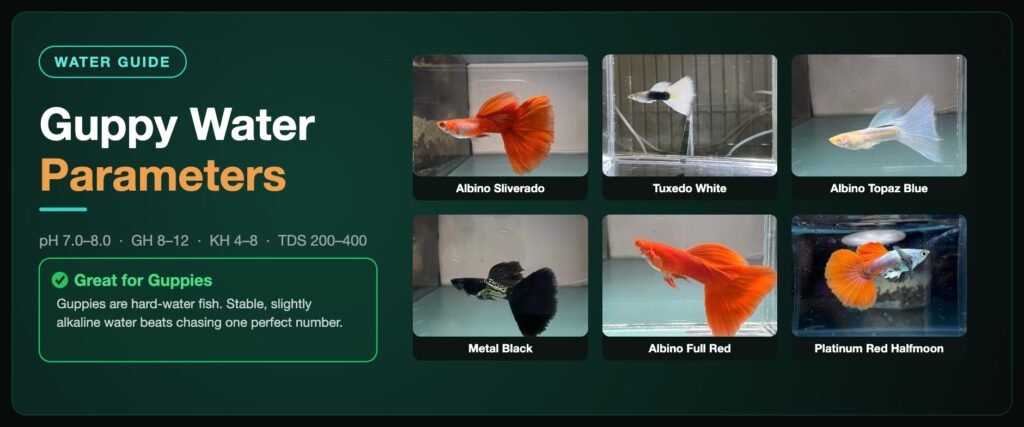
Guppy Water Parameters at a Glance
| Parameter | Ideal range | Tolerable | What it affects |
|---|---|---|---|
| Temperature | 24-26 C | 22-28 C | Metabolism, breeding rate, lifespan |
| pH | 7.0-8.0 | 6.8-8.5 | Comfort, colour, fry survival |
| GH (general hardness) | 8-12 dGH | 6-20 dGH | Bone, scale and fin development |
| KH (carbonate hardness) | 4-8 dKH | 3-12 dKH | Stops pH swinging |
| TDS | 200-400 ppm | 150-500 ppm | Overall mineral load |
| Ammonia | 0 ppm | 0 ppm | Gill damage, sudden deaths |
| Nitrite | 0 ppm | 0 ppm | Suffocation, red gills |
| Nitrate | Under 20 ppm | Under 40 ppm | Long-term health, fry growth |
Stability Beats Perfection
A guppy that has lived its whole life at pH 8.2 is perfectly healthy. Move that same fish to pH 7.0 in an afternoon and you may lose it. The shock of a fast change does far more damage than the value itself, which is why chasing a textbook number with chemicals is one of the most common ways beginners kill their fish.
So before you buy anything, test your tap water and write the numbers down. If they land anywhere in the tolerable column above, your job is simply to keep them there.
pH: Aim High, Not Neutral
Wild guppies come from hard, mineral-rich water in the Caribbean and northern South America, and they are still built for it. Anywhere from 7.0 to 8.0 is comfortable. Most Indian tap water sits in exactly that band, which is one reason guppies do so well here.
Do not use pH-down or pH-up products in a guppy tank. They work for a few hours, then the carbonate hardness in your water pulls the pH straight back, and your fish take the round trip twice. If your pH genuinely is extreme, change the source water rather than treating it.
GH and KH: The Pair That Actually Matters
These two get skipped more than any other test, and they explain a lot of mysterious guppy problems.
GH is the calcium and magnesium in your water. Guppies use it to build bone, scales and fin rays. Raise fry in soft water and you get small, weak fish with poor finnage no matter how well you feed them. Aim for 8 to 12 dGH.
KH is the carbonate buffer. It is what stops your pH crashing overnight when the tank produces acid faster than the water can absorb it. Below about 3 dKH, pH becomes unstable and swings, which is when you get unexplained morning losses. Aim for 4 to 8 dKH.
If you keep soft water and cannot understand why your fry stall or your adults look thin, test GH before you change anything else.
Raising Hardness Without Shocking the Tank
- Add crushed coral or coral sand. Either mixed into the substrate or in a mesh bag in the filter. It dissolves slowly and only when the water needs it, so it is almost impossible to overdo. Our guide to substrate for guppy tanks covers which mineral substrates do this best.
- Use a proper remineraliser if you are on RO or very soft water. Dose it into the new water in a bucket, never straight into the tank.
- Move slowly. No more than about 2 dGH of change per week. Hardness is one of the easiest things to raise too fast.
- Skip the seashells and marble chips folklore unless you have tested the result. They work, but unpredictably.
Ammonia, Nitrite and Nitrate
These are not really water parameters so much as a report card on your filter. Ammonia and nitrite should both read zero at all times in an established tank. Any reading above zero means the biological filter cannot keep up, usually because the tank is new, overstocked, overfed, or you cleaned the filter media in tap water.
Nitrate is the end product and the one you export with water changes. Under 20 ppm is comfortable, under 40 is acceptable, and consistently above that shows up as slow fry growth and shorter lifespans long before it shows up as a dead fish. Our guppy water change guide has a schedule by tank size.
Temperature
Guppies live comfortably between 22 and 28 C. The warmer end speeds up metabolism, colour and breeding but shortens life; the cooler end does the opposite. Most keepers settle around 24 to 26 C as a compromise. What matters more than the exact figure is that it does not swing by several degrees between day and night. If your room does, our guide to whether guppies need a heater is worth a read, and there is more detail in our guppy tank temperature guide.
What to Test, and How Often
| When | Test | Why |
|---|---|---|
| New tank, every 2-3 days | Ammonia, nitrite | Catch the cycle before it catches your fish |
| Established tank, monthly | Nitrate, pH, GH, KH | Confirm nothing has drifted |
| After any loss | Ammonia, nitrite, nitrate | Rules out the most common cause first |
| Before adding new fish | pH, GH, temperature | So you can match your acclimation to the gap |
| Changing water source | Everything | Tap water composition changes seasonally in many cities |
A liquid master test kit is worth the extra money over strips. Strips are fine for a quick reassurance check and unreliable for the readings you actually act on.
Frequently Asked Questions
What is the ideal pH for guppies?
Between 7.0 and 8.0. They tolerate 6.8 to 8.5 as long as the value is stable, so do not chase a number with chemicals.
Do guppies need hard water?
Yes. They are hard-water fish. Around 8 to 12 dGH gives the best fin development and fry growth. Very soft water is one of the most common hidden causes of stunted guppies.
What TDS is best for guppies?
Roughly 200 to 400 ppm. TDS is a useful shortcut for spotting drift between water changes, but it does not tell you which minerals are present, so test GH and KH too.
Can guppies live in tap water?
In most of India, yes, once it is dechlorinated and temperature-matched. Our water preparation guide walks through the process.
Why does my pH keep dropping?
Low KH. Without carbonate buffer the acid your tank produces has nothing to neutralise it. Add crushed coral and the problem usually solves itself within a couple of weeks.
How different can new water be from tank water?
Keep temperature within about 1 C and pH within about 0.2 for routine water changes. For new fish arriving from a different source, drip acclimate instead, as described in our guide to acclimating guppies to a new tank.
Test once, write the numbers on a sticker on the side of the cabinet, and stop guessing. Almost every guppy problem that looks like a disease turns out to be one of the eight rows in that first table.