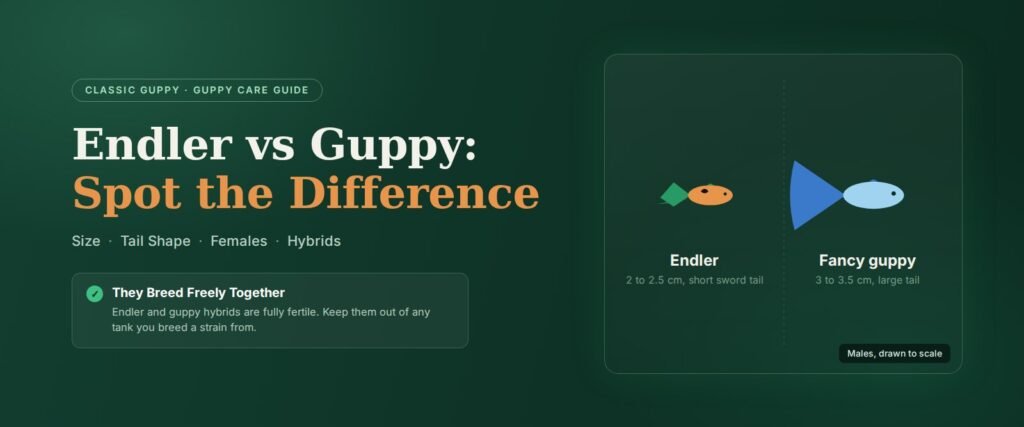

Endlers are showing up in more Indian fish shops every month, usually labelled endler guppy and priced a little above common guppies. They are small, bright and active, and at first glance they look like a guppy that forgot to grow its tail. The endler vs guppy question matters more than it seems, because the two cross freely and their babies are fully fertile. For someone keeping a single fancy guppy strain, one endler male in the wrong tank can undo years of selective breeding in a single generation.
The Short Answer
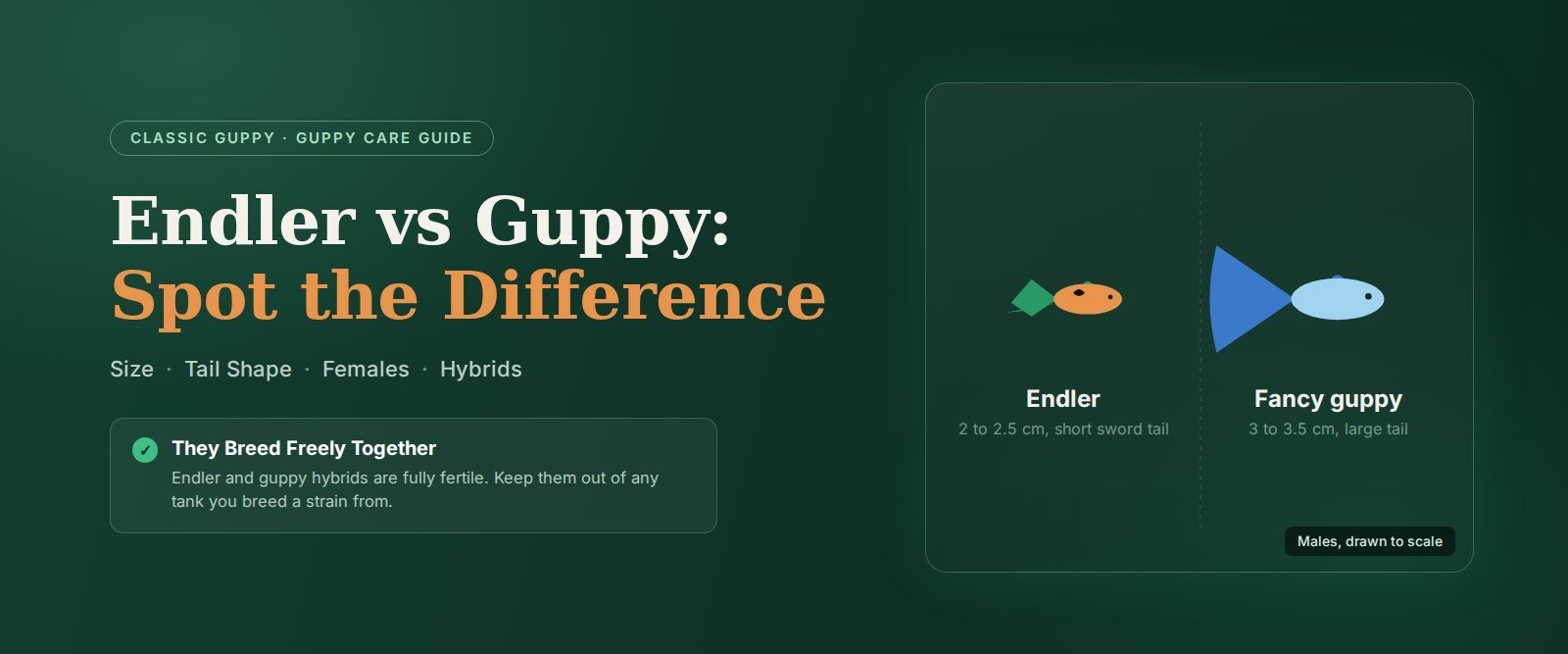
- Size: endler males are smaller, around 2 to 2.5 cm. Guppy males are usually 3 to 3.5 cm.
- Tail: endlers have short tails, often with small sword points. Fancy guppies have large fan, delta or ribbon tails.
- Colour: endlers show bright metallic patches, often orange, green and black, with a dark bar or comma on the side.
- Females: endler females are small, slim and plain gold or silver. Fancy guppy females are larger and often have a coloured tail.
- Breeding: endlers and guppies interbreed easily and the hybrids are fertile. Keep them in separate tanks if you breed guppies.
What Exactly Is an Endler?
The endler is a small livebearer from northeastern Venezuela. The fish was collected as early as 1937, but it became known in the hobby after biologist John Endler found it in 1975 in Laguna de Patos, a warm, hard water lagoon near the town of Cumana. It was only formally described as its own species, Poecilia wingei, in 2005.
That makes the endler and the guppy, Poecilia reticulata, very close relatives in the same genus. Some scientists still argue about whether they are truly separate species or two forms of one species. For fishkeepers the important point is simpler: they recognise each other as mates. The Practical Fishkeeping account of endler history notes that soon after the fish reached European keepers, it was crossed with guppies, and that most endlers in the hobby today are hybrids.
Endler vs Guppy: Side by Side
| Feature | Endler | Fancy guppy |
|---|---|---|
| Male size | About 2 to 2.5 cm | About 3 to 3.5 cm body |
| Female size | About 3 to 3.5 cm, slim | About 4 to 6 cm, deeper body |
| Male tail | Short, often with upper or lower sword points | Large, flowing, many shapes |
| Male colour | Metallic patches, black bar or comma, bright orange | Bred colours and patterns, solid or mosaic tails |
| Female colour | Plain gold or silver, clear fins | Often coloured tail matching the strain |
| Temperament | Very active, males chase constantly | Active, slightly calmer |
| Best tank | Nano tanks, planted setups | Breeding and display tanks |
Endler vs Guppy: How to Identify an Endler
Look at the male tail first
The tail is the quickest giveaway. A true endler male has a short caudal fin, roughly as long as it is wide. Many show a small sword extension at the top, bottom or both. A fancy guppy male has a tail that is a big part of his total length, bred into shapes like delta, half moon, fan or ribbon. Our guide to guppy tail types shows the common shapes.
If a fish sold as an endler has a long, wide tail, it is almost certainly a hybrid.
Check the body markings
Endler males usually carry metallic patches, bright orange and green that seem to shift as the fish turns, and a black bar or comma shaped mark on the side. Fancy guppies are selected for even colour across the body or a defined pattern such as mosaic, grass or snakeskin.
Look at the size of the pair
A fully grown endler male sitting next to a fully grown guppy male looks noticeably small, almost like a juvenile. Endler females are the clearest clue of all. They stay slim, small and plain with clear fins, while fancy guppy females from most strains grow larger and carry tail colour. Our male vs female guppy guide explains how guppy females differ by strain.
Ask where the line came from
Some keeper groups maintain lines traced back to wild collected fish from the original lagoons, and these are usually sold with their location history. A fish sold simply as endler guppy, Japan blue endler or tiger endler in a general shop is very likely a hybrid. That does not make it a bad fish. It just means you should not expect it to breed true.
Why Endlers and Guppies Should Not Share a Breeding Tank
Endler males chase females constantly and they are not picky about species. In a mixed tank they will mate with guppy females, and the female can then store that sperm and keep producing hybrid fry for several months afterwards, even after the endler has been removed.
For a display tank with no breeding plans, this does not matter much. For anyone building a guppy line, it does.
- Tails shrink. Hybrid sons usually show a tail somewhere between the two parents, and the big fancy shape you selected for is gone.
- Colours scramble. The careful colour work in a strain breaks into mixed patterns.
- It does not wash out quickly. Because hybrids are fertile, endler traits keep appearing for generations. Our guide to guppy generations F1, F2 and F3 explains how traits move through a line.
The same is true in the other direction. Endler keepers who want pure fish need to keep guppies well away.
Endler vs Guppy Care Differences
Day to day, endlers and guppies need almost the same care. Both prefer warm, hard water, both eat small mixed food, and both are hardy once settled.
- Temperature: both do well at 24 to 28 C. Endlers come from warm lagoons and tolerate heat well.
- Water: hard, slightly alkaline water suits both. See our guppy water parameters guide for the full numbers.
- Food: endlers have smaller mouths, so crush flakes finely and use micro pellets and baby brine shrimp.
- Tank size: endlers do well in smaller tanks than fancy guppies, and their low bioload suits nano setups.
- Fry: endler fry are smaller at birth. They need very fine food for the first week.
Endler males are also hard on females. Keep at least two or three females for every male, the same principle covered in our male to female guppy ratio guide.
Endler vs Guppy: Which Should You Keep?
Choose endlers if you have a small planted tank, want very active fish with natural looking colour, and are not breeding a show strain. Choose fancy guppies if you want large tails, defined strains and the satisfaction of improving a line. If you want both, keep two tanks. It is the only reliable way to keep both lines honest.
Frequently Asked Questions
Can endlers and guppies breed together?
Yes. They breed freely and their fry are fully fertile, which is why most endlers in the hobby today carry some guppy blood.
Are endlers just small guppies?
No. Endlers are Poecilia wingei, described as a separate species in 2005. They are very close relatives of guppies, which is why they hybridise so easily.
How do I know if my endler is pure?
The only real confirmation is a traceable line from known wild collected fish. In practice, a short tailed male with clean endler markings and plain slim females is a good sign, but shop fish are usually hybrids.
Can I keep endlers and guppies in the same tank?
You can if you are not breeding either. If you want a pure guppy strain or a pure endler line, keep them apart, including the females.
Do endlers live longer than guppies?
They have a similar lifespan of around two years in good conditions. Our guppy lifespan guide covers what affects it.
Why are endlers more expensive than common guppies?
Lines with known history take effort to keep pure. Ordinary shop endlers are often priced similar to common guppies.
The Short Version
The endler vs guppy difference is easy to see once you know where to look. Endlers are smaller, shorter tailed and more metallic than fancy guppies, and their females stay slim and plain. They are close enough relatives to breed freely with guppies and produce fertile fry, so most fish sold as endlers are already hybrids. Enjoy them in a planted tank, but keep them away from any tank you use to breed a guppy strain.
If you want guppies that breed true to their strain, browse our home bred lines in the Classic Guppy shop, shipped across India with live arrival guaranteed, or read our guppy strain guide to compare them.