
If you have been shopping for guppies, you have probably seen a seller describe a pair as F1 or F2 and wondered whether it means the fish is better, purer, or just more expensive. It is none of those things on its own. F1 simply means first generation — the first batch of fry from a particular pair — and the number climbs by one with every further cross. What makes the label useful is what it tells you about how predictable the next batch of fry will be.
What Does F1 Mean in Guppies?
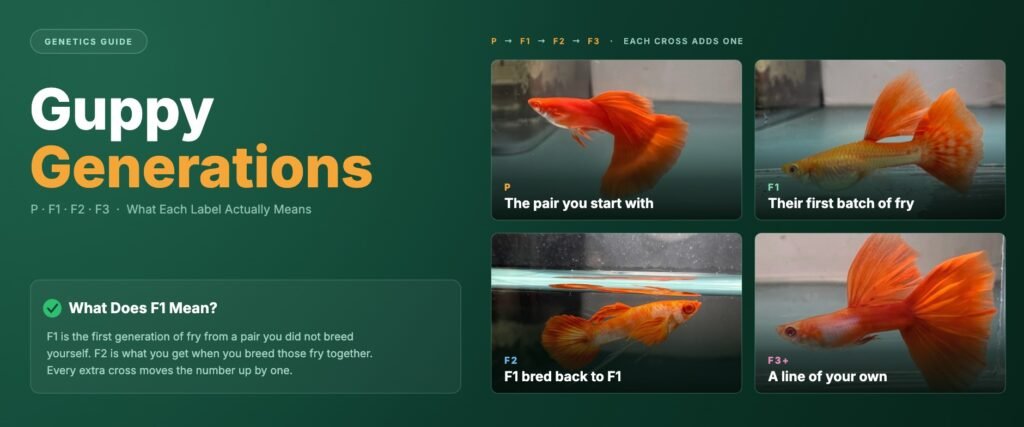
The letters come from genetics, not from marketing. P is the parental generation: the two fish you put together. F stands for filial, meaning offspring, so F1 is the first filial generation — the fry those two parents produce. Breed two of those F1 fry together and their fry are F2. Breed two F2s and you get F3, and so on.
There is a second use of the same label that causes most of the confusion, and it comes from the wild-caught side of the hobby. There, F1 means the first generation bred in captivity from wild parents. That usage matters for a wild-caught tetra or pleco. It does not really apply to fancy guppies, which have been bred in tanks for well over a century. When a guppy seller in India says F1, they almost always mean the first generation from a specific cross.
The Generation Ladder, P to F7
| Label | What it is | What you actually see |
|---|---|---|
| P | The two parents you cross | The pair you buy or pick out of your own tank |
| F1 | Their fry | Remarkably uniform, often the strongest batch |
| F2 | F1 bred to F1 | Traits split apart; hidden genes reappear |
| F3 | F2 bred to F2 | Your selection starts to hold from batch to batch |
| F4–F6 | Continued selection | The line begins to look predictable |
| F7+ | A fixed line | What breeders mean by an established strain |
A guppy generation is short. Females carry fry for roughly 28 to 31 days and the fry are old enough to breed at about three months, so you can realistically move one step up this ladder every three to four months. Four generations a year is achievable in a warm room. Our guppy breeding time guide covers the cycle in detail.
Why F1 Fry Look So Uniform
The first thing people notice about an F1 batch is how similar the fry are to each other. There is a reason for that. When you cross two lines that have each been bred true for different traits, every F1 fry inherits one copy of each version of the gene. They all end up with the same combination, so they all look the same, and the dominant trait is what shows.
F1 fry also tend to be noticeably vigorous — faster growing, better eaters, more resistant to a bad week. Breeders call this hybrid vigour, and it is the main reason an F1 batch often looks like the best fish you have ever raised. It is genuinely real, but it is a one-generation effect, and it is exactly what makes the next step surprising.
F2 Is the Generation That Catches People Out
Breed those beautiful, matched F1 fish together and the F2 batch comes out mixed. Colours you have never seen appear. Tails vary. Some fry look like the original grandparents rather than their parents. Nothing has gone wrong — this is the recessive genes that were hidden in every F1 fish finally getting the chance to pair up.
For a single trait with clean dominance, the classic ratio is three fish showing the dominant form to every one showing the recessive. In practice, most of what makes a guppy attractive — body colour, tail shape, size, iridescence — is controlled by several genes at once, so you will not get a tidy 3:1 split. What you will reliably get is variation. F2 is where you find out what your line is really carrying.
Guppy Colour Genes Do Not All Behave the Same Way
Guppies have a quirk that makes their genetics different from most aquarium fish: a large share of male colour genes sit on the Y chromosome. Because a father passes his Y to every son and never to a daughter, those patterns travel strictly down the male line and never show up in females at all.
| Where the gene sits | How it passes | What that looks like in your tank |
|---|---|---|
| Y chromosome | Father to son only | Male-only patterns. Females never show them and never pass them on |
| X chromosome | From either parent | Can hide in a female and reappear in her grandsons |
| Autosomal | From either parent | Shows in both sexes and follows the standard ratios |
This is why picking the female matters far more than beginners expect. She carries and passes traits she does not display herself. Our guide on choosing a female for a superior strain goes through what to look for.
How Many Generations Does It Take to Fix a Strain?
Longer than most people hope. Getting a trait to appear in nearly every fry, batch after batch, usually takes somewhere between five and ten generations of deliberate selection — roughly two to three years of steady work. Each round means raising a full batch, growing them out far enough to judge properly, keeping only a handful, and culling honestly.
The complication is that repeatedly breeding close relatives eventually causes inbreeding depression: smaller adults, shorter fins, fewer fry per drop, bent spines, and a general loss of the vigour you saw at F1. Serious breeders manage this by keeping two or three separate family lines of the same strain and crossing between them every few generations, which restores vigour without letting unrelated genes back in.
Line Breeding, Inbreeding and Outcrossing
- Inbreeding — brother to sister. The fastest way to fix a trait and the fastest way to lose vigour. Useful in short bursts, not as a habit.
- Line breeding — crossing within an extended family, such as a fish back to a grandparent or to a cousin line. Slower, far more sustainable, and what most established strains are built on.
- Outcrossing — bringing in an unrelated fish of the same strain. Restores vigour and resets some of your consistency, so the generation count effectively starts again for the traits involved.
Whichever route you take, keep written records. A generation label is only meaningful if you know which pair produced which batch and when. A notebook or a phone note per breeding tank is enough.
What Generation Are the Guppies You Buy?
Ask, and be a little wary of a confident answer with nothing behind it. Any seller can print F1 on a listing. What actually tells you something is whether they can describe the parents, how long they have kept the line, and whether the fish in their tanks look consistent with each other.
Everything we sell is bred in our own tanks in Pune from lines we have grown out ourselves, and pairs are sold as a male and a female of the same strain, which is what you need if you intend to breed rather than just keep. You can see the current lines in the shop, and the strain guide explains what separates one from another.
Four Mistakes Worth Avoiding
- Treating F1 as a grade of quality. It describes a position in a family tree, not how good the fish is. An F5 from a well-selected line will usually beat an F1 from a careless cross.
- Expecting F2 to look like F1. It will not, and that is not a fault in the fish. Plan for variation and select from it.
- Judging fry too early. Colour and finnage are not settled until around three to four months. Cull before that and you will throw away your best fish.
- Mixing strains in one tank and still counting generations. A female stores sperm for months and can drop several broods from one mating. Once strains mix, your labels mean nothing.
The Short Version
P is the pair, F1 is their fry, and each cross after that adds one to the number. F1 is uniform and vigorous, F2 is where the variation shows up, and it takes five to ten generations of honest selection before a line breeds true. If you are just starting, buy a good pair, raise the F1, and pay close attention to what F2 shows you — that batch will tell you more about your fish than any label on a listing. When you are ready to set up properly, our breeding guide covers tanks, water and feeding.