Guppies will beg at the glass every single time you walk past, and they will keep eating long after they need to. That combination is why overfeeding, not underfeeding, is the number one feeding mistake in the hobby. A guppy that misses a meal is fine. A guppy swimming in the ammonia produced by yesterday leftover food is not.
The Short Answer
- Adults: two small meals a day, six days a week.
- Juveniles (1 to 3 months): three small meals a day, every day.
- Fry (0 to 4 weeks): four to five tiny meals a day, every day.
- Every tank: one fasting day a week for adults.
If you can only feed once a day because of work, that is genuinely fine for adult guppies. Two meals is better for condition and colour, but one proper feed beats two rushed ones.
The 30-Second Rule
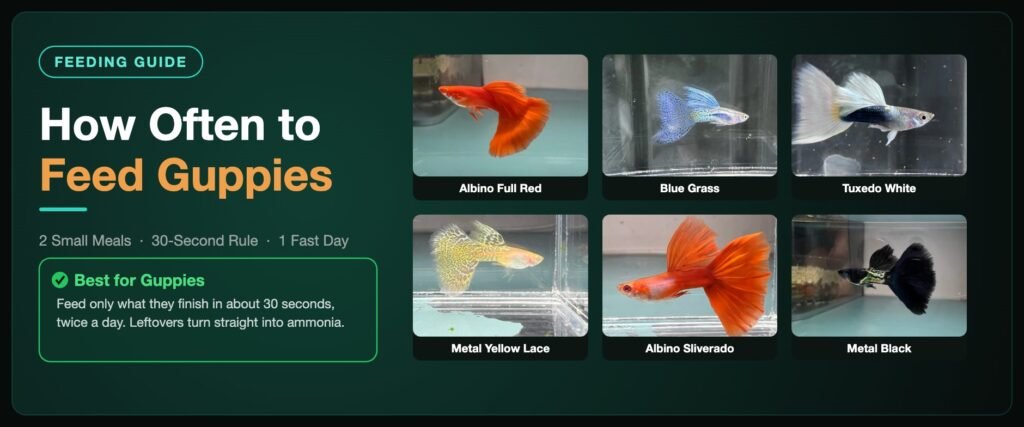
Forget measuring. Add a small pinch and watch. Everything should be eaten within about 30 seconds, with nothing drifting down past the fish to settle on the substrate. If food reaches the bottom, you fed too much. If they are still hunting the surface after a minute, you can add a touch more next time.
This one habit does more for water quality than any filter upgrade. Uneaten food breaks down into ammonia, ammonia stresses gills, and stressed guppies get sick. That chain is behind a surprising share of the losses in our guide to why guppies die.
Feeding Schedule by Age
| Age | Meals per day | Portion | Notes |
|---|---|---|---|
| Fry, 0-4 weeks | 4-5 | Barely visible dusting | They have tiny stomachs and grow fastest now. Never skip a day. |
| Juvenile, 1-3 months | 3 | Small pinch | This is where final size and finnage are decided. |
| Adult, 3 months plus | 2 | Small pinch | One fasting day a week. |
| Breeding females | 2-3 | Small pinch | Slightly more protein while carrying. |
| Any age, tank under 24 C | 1-2 | Reduced | Cold slows digestion. Feed less, not more. |
For the fry stage specifically, our guide to feeding fast-growing guppy fry goes into the food types week by week.
A Sensible Week
Variety matters more than brand. Guppies are omnivores and a flake-only diet shows up eventually as dull colour and digestive trouble. A rotation that works:
| Day | Morning | Evening |
|---|---|---|
| Monday | Quality flake | Frozen or live brine shrimp |
| Tuesday | Micro pellet | Quality flake |
| Wednesday | Quality flake | Blanched vegetable or spirulina |
| Thursday | Micro pellet | Frozen bloodworm (small portion) |
| Friday | Quality flake | Live or frozen daphnia |
| Saturday | Micro pellet | Quality flake |
| Sunday | Fasting day | Fasting day |
You do not need all of that. Flake plus one frozen food plus something plant-based covers it. If you are watching costs, our notes on saving on guppy food without cutting nutrition are worth a look.
Why the Fasting Day Helps
One day a week with no food lets the gut clear completely. It reduces constipation and bloating, which are two of the most common non-infectious problems in well-fed guppies, and it gives your filter a small break too. Adults handle it without any distress. Do not fast fry or juveniles.
Signs You Are Overfeeding
- Food visible on the substrate an hour after feeding.
- Cloudy water a day or two after a big feed.
- Long, pale, trailing waste hanging from the fish.
- Rising nitrate between water changes.
- Snail population suddenly exploding.
- Bloated, rounded bellies on males.
Signs You Are Underfeeding
- Sunken belly seen from above, especially on females.
- Constant grazing on plants, glass and substrate.
- Fry that stall in size for weeks.
- Aggression at feeding time in an otherwise calm tank.
A healthy adult guppy is gently rounded, not concave and not swollen. Look at them from above once a week and you will spot both problems early. If bellies look wrong in a way food does not fix, our guide to common guppy diseases covers what else it might be.
Holidays and Travel
Healthy adult guppies handle three to four days with no food without any harm. Do not use those dissolving holiday blocks, which foul the water badly in a small tank. For a week or more, either arrange an automatic feeder set to one small daily portion, or ask someone to feed once every second day and pre-portion the food into small containers so they cannot be generous.
A large water change the day before you leave and another the day you return covers most of the rest.
Frequently Asked Questions
How often should I feed guppies?
Twice a day for adults, six days a week, with one fasting day. Fry and juveniles need more frequent, smaller meals.
How much food is one pinch?
However much they finish in about 30 seconds. For six adults that is usually less than you think, roughly what fits on the tip of a matchstick.
Can guppies go a week without food?
Adults can manage several days, and a week is survivable but not something to plan for. Fry cannot. Arrange a feeder or a helper if you will be away longer than four days.
Should I feed guppies before or after a water change?
After, and a smaller portion than usual. Feeding first means more waste going into water you are about to disturb. Our water change guide covers the rest of the routine.
Do guppy fry need food at night?
No. Feed them during daylight hours only. If you want faster growth, add a meal in the early morning rather than one late at night.
Is bloodworm safe for guppies?
Yes, in small amounts and not every day. It is rich and easy to overfeed. Once or twice a week as part of a rotation is plenty.
Feed small, feed often, and let them look slightly hungry. Guppies raised that way live longer, colour up better and keep the water clean enough that half of the usual problems never appear. You can see the strains we raise on exactly this routine in the Classic Guppy shop.