Most new guppies that die in the first two weeks are not killed by disease. They are killed by their own waste, in a tank that was never ready for them. That invisible process is called cycling, and skipping it is the single most common reason a brand-new setup crashes.
The Short Answer
- What it is: growing a colony of bacteria in your filter that turns toxic ammonia into nitrite, then into much safer nitrate.
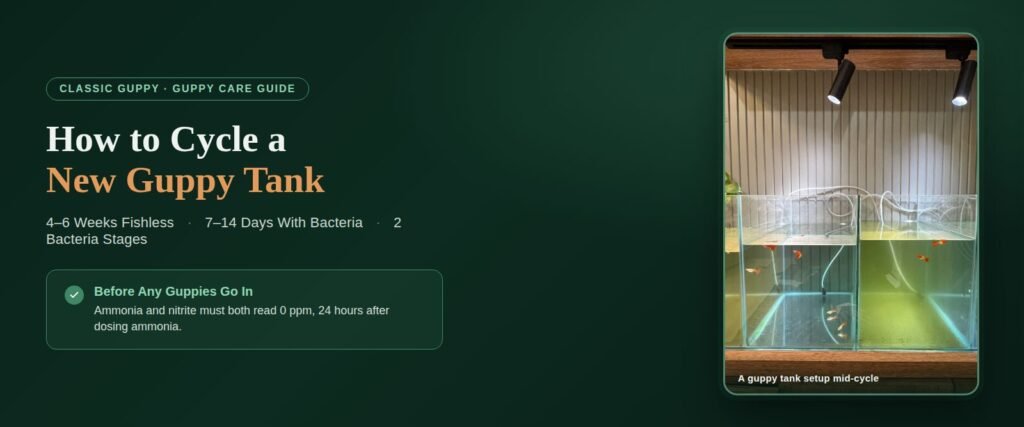
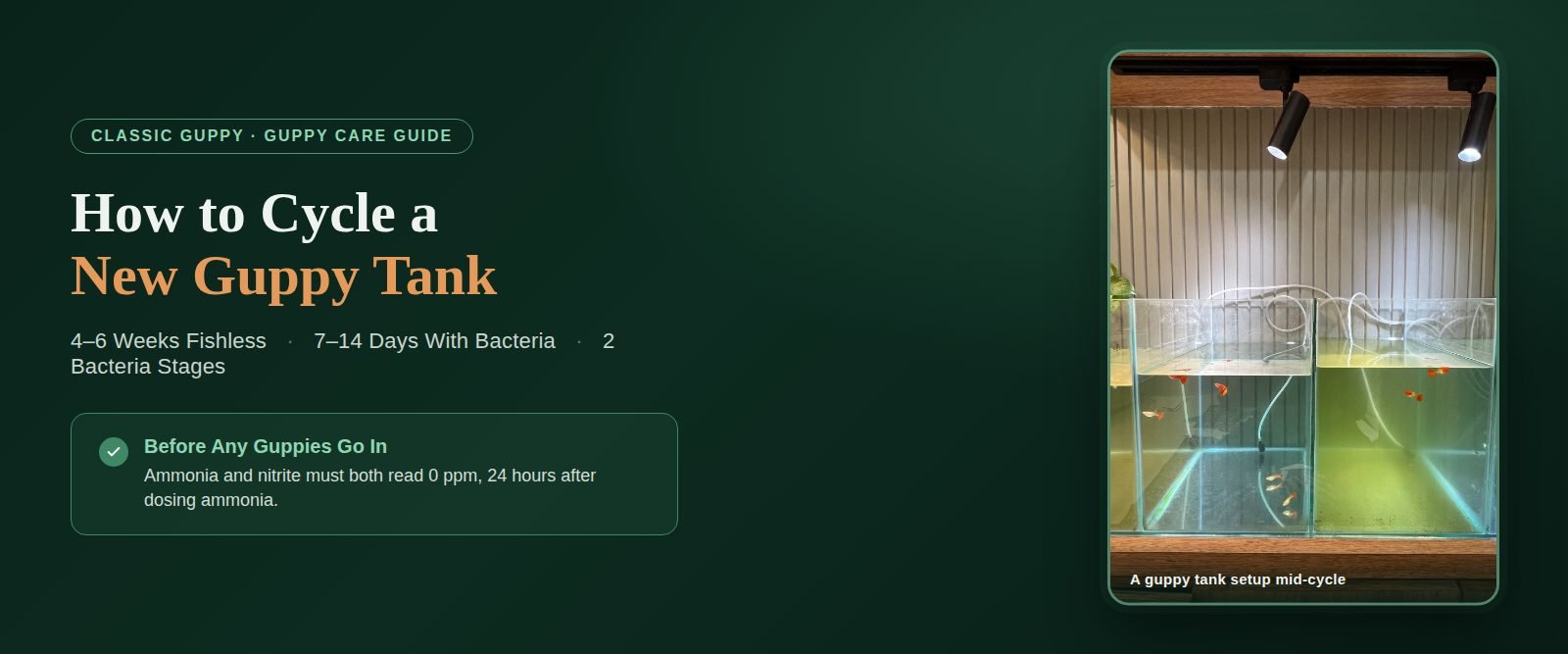
- How long: 4 to 6 weeks with a fishless cycle, or 7 to 14 days with quality bottled bacteria.
- When guppies go in: only once ammonia and nitrite both read 0 ppm, 24 hours after dosing ammonia.
- Fastest safe route: seed your filter with mature media or gravel from an established, healthy tank.
If you already added guppies to an uncycled tank, do not panic and do not tear it down. Test your water, start doing daily 25 to 30 percent water changes, and read the “already have fish in there” section below.
Why a New Tank Can Kill Guppies That a Filter Never Touched
Every gram of food and every bit of guppy waste breaks down into ammonia. In an aquarium, ammonia does not go anywhere on its own. It builds up in the water and burns fish gills at surprisingly low concentrations, which is why a tank that looks perfectly clear can still be lethal.
A cycled tank fixes this with two types of bacteria that live mostly inside your filter media, not in the water column. The first group, Nitrosomonas, converts ammonia into nitrite, which is still toxic but in a different way. The second group, Nitrospira, converts that nitrite into nitrate, which is comparatively harmless in the small amounts a home aquarium produces and is removed through routine water changes. This two-step conversion is what people mean by “the nitrogen cycle,” and it is the entire point of cycling a tank before fish go in.
Fishless Cycling, Step by Step
- Set everything up first. Substrate, decor, filter, heater, and dechlorinated water, running for 24 hours with the heater at 77 to 82°F (25 to 28°C). Warmer water speeds up bacterial growth considerably.
- Add an ammonia source. Pure ammonia (no surfactants, no perfume, nothing that foams when shaken) dosed to 2 to 4 ppm is the most controllable option. A pinch of fish food left to rot works too, just less precisely.
- Test daily with a liquid kit. Strip tests are not accurate enough for this. Track ammonia, nitrite, and nitrate from day one so you can actually see the cycle happening.
- Watch for the nitrite spike. Around week two or three, ammonia will start dropping and nitrite will climb, sometimes to levels that turn the test tube deep purple. This is normal and means the first bacteria colony has established.
- Wait for both to hit zero. The cycle is finished only when a fresh dose of ammonia reads 0 ppm ammonia and 0 ppm nitrite within 24 hours, with nitrate visibly present.
- Do a large water change before adding fish. This brings nitrate down to a safe level without harming the bacteria you just grew, since they live on surfaces, not in the water itself.
The Fast Way: Seeding an Established Filter
If you or someone you know has a healthy, disease-free tank already running, you can skip most of the waiting. A handful of mature filter media, a sponge, or even a cup of gravel from that tank introduces a working bacteria colony straight away. Combined with a quality bottled bacteria product, this can bring a brand-new tank to a fish-safe state in as little as a week, which is exactly how a lot of guppy breeders set up new tanks quickly without gambling on fish-in cycling.
What About a Tank That Already Has Guppies In It?
Fish-in cycling happens more often than any care guide would recommend, usually because someone did not know cycling was a thing until after the fish were already swimming. Guppies can survive it, but only with intervention on your part:
- Test ammonia and nitrite daily.
- Do a 25 to 30 percent water change any time either reads above 0.25 ppm.
- Add a dechlorinator that also detoxifies ammonia (most modern water conditioners do this) at every change.
- Do not add more fish until the cycle finishes. This is the mistake that turns a manageable situation into a mass die-off.
Mistakes That Undo a Cycle
- Rinsing filter media in tap water. Chlorine and chloramine kill the bacteria you worked weeks to grow. Rinse media in removed tank water only.
- Cleaning the filter “to be safe” once fish are in. A fully cycled filter needs a gentle squeeze in old tank water occasionally, never a full scrub.
- Adding a full stock of fish on day one. A newly cycled tank supports a light bioload at first. Add guppies gradually over two to three weeks even after the cycle is done.
- Giving up around week two. The nitrite spike is the ugliest, most discouraging part of the process and also the surest sign it is working.
Frequently Asked Questions
How long does it take to cycle a tank for guppies?
Four to six weeks with a plain fishless cycle. Bottled bacteria products can shorten that to 7 to 14 days, and seeding from an established filter can make a tank fish-ready in about a week.
Can I just add guppies right away if I use a water conditioner?
No. A water conditioner neutralizes chlorine and detoxifies some ammonia temporarily, but it does not create the bacteria colony that processes ongoing waste. Without that colony, ammonia and nitrite will still build up between doses.
Does a heater actually speed up cycling?
Yes. Nitrifying bacteria reproduce fastest between 77 and 86°F (25 to 30°C), which is also comfortably within the ideal guppy tank temperature range, so there is no downside to running the heater during cycling.
My ammonia will not drop even after three weeks. What is wrong?
Check your source water for ammonia or chloramine first, since some tap water already contains trace ammonia after dechlorination. Otherwise confirm your test kit reagents have not expired, and make sure the tank is staying at a stable warm temperature.
Do I need to keep testing once the tank is cycled?
Test weekly for the first month with fish in, then it becomes about routine maintenance. See our guide to guppy water parameters for the ranges to aim for long term, and our water change schedule for keeping nitrate in check afterward.
The Short Version
A cycled tank means bacteria, not luck, are keeping your water safe. Run the tank fishless for 4 to 6 weeks while dosing ammonia and testing daily, or cut that down to about a week by seeding with mature filter media. Either way, guppies go in only after ammonia and nitrite both hit zero within a day of dosing. Once your tank is cycled, move straight into our step-by-step guide to acclimating new guppies so the fish arrive into water they can actually handle.
Once your tank has finished cycling, it’s ready for guppies. Browse our full range of home-bred strains, or start with an easygoing beginner strain like the Albino White Guppy. Adding fish to an already-established tank instead? See our quarantine guide first.