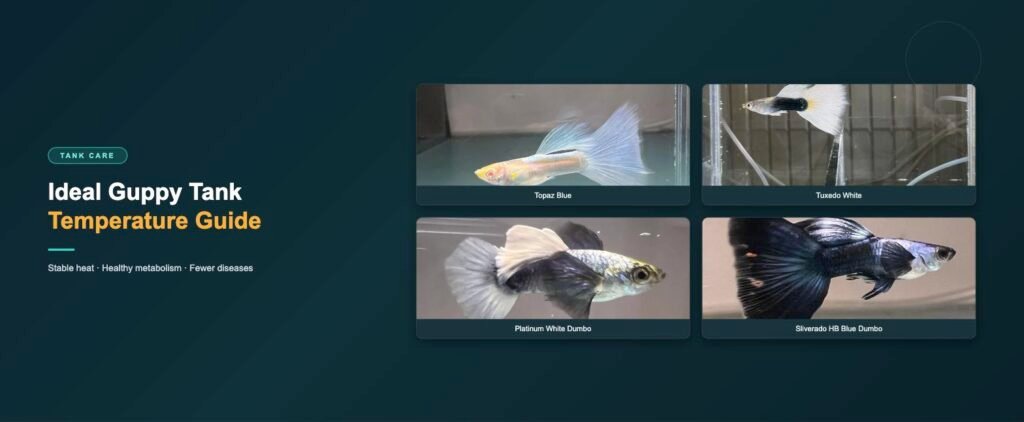
Guppies are tropical fish, and getting the tank temperature right — and keeping it there consistently — has more influence on their health, colour, and breeding success than almost any other single setup decision. Too cold and their metabolism slows to the point of illness; too hot and oxygen levels drop while stress rises. Here’s the ideal range, why stability matters as much as the number itself, and the equipment that makes maintaining it simple rather than stressful.
Quick Takeaways
- Ideal range: most guppies thrive between 24–27°C (75–81°F).
- Stability beats precision: a steady 25°C is safer than a swinging 23–28°C.
- Size your heater to your tank: undersized heaters struggle to hold steady in larger volumes.
- Verify with a separate thermometer: don’t rely solely on a heater’s built-in display.
- Plan for outages: a backup plan protects fish during power cuts or heater failure.
- Watch behaviour: lethargy or gasping often signals a temperature problem before a thermometer does.
What Is the Ideal Guppy Tank Temperature?
Most guppies do best in a range of about 24–27°C (75–81°F), with many keepers settling on 25–26°C as a comfortable middle ground for general health, colour, and activity. Slightly warmer water, toward the upper end of that range, can speed up breeding and fry growth, while slightly cooler water within range tends to support a longer lifespan. Straying too far outside this window in either direction — particularly below 22°C or above 29°C for extended periods — puts real stress on their metabolism and immune system.
Why Temperature Stability Matters More Than the Exact Number
A tank that holds a rock-steady 24°C is generally safer for guppies than one that swings between 23°C and 28°C throughout the day, even though the second tank’s average is technically within range. Sudden swings, especially drops of more than 2–3°C in a short time, shock a guppy’s system and are a common trigger for illness following a water change or an overnight room temperature change. Prioritising a stable, reliable setup matters more than chasing an exact “perfect” number.
Choosing the Right Heater for Your Tank Size
A heater that’s undersized for your tank will run constantly and still struggle to hold a stable temperature, especially in a cold room, so it’s worth sizing up rather than down. For small 1–2 gallon tanks, a low-wattage heater such as a Fluval Mini Heater or a hygger Mini Submersible Heater is usually enough. Mid-sized 10–20 gallon tanks generally do well with an adjustable heater like the Fluval E Series or Eheim Jager, while larger 30+ gallon tanks benefit from a higher-wattage option such as the Cobalt Aquatics Neo-Therm, which holds temperature accurately even in larger volumes.
Thermometers Worth Trusting
A heater’s built-in display isn’t always accurate, so a separate thermometer is worth having regardless of which heater you use. A simple stick-on analogue thermometer works for a quick glance, but a digital option such as the Fluval Digital Thermometer gives a more precise reading and is easy to check daily. Checking an independent thermometer regularly, rather than trusting a single device, is the easiest way to catch a failing heater before it becomes a real problem.
Backup Options for Power Outages or Winter
Power cuts and unexpectedly cold rooms are the two most common ways a stable tank suddenly isn’t, so it’s worth having a simple backup plan. An inexpensive battery-powered air pump keeps oxygen moving during a power outage, buying time before temperature becomes critical, while wrapping a tank in towels temporarily slows heat loss during a cold spell. For anyone in a consistently cold climate, a reliable controller such as the Inkbird ITC-308 adds an extra layer of safety by automatically managing the heater.
Signs Your Tank Temperature Is Off
Lethargy, clamped fins, gasping at the surface, or fish gathering near the heater or filter outflow often signal a temperature problem before your thermometer confirms it. Checking behaviour daily, alongside a quick thermometer glance, catches most heater failures early enough to fix before any real harm is done.
Getting guppy tank temperature right isn’t complicated — aim for 24–27°C, prioritise stability over precision, and back up your heater with a separate thermometer you actually trust. Get that combination right and temperature stops being something you have to think about day to day.
Temperature is one of eight numbers worth knowing. Our full guide to guppy water parameters covers pH, GH, KH and the rest.