
Walk into any aquarium shop in India and the guppies, mollies and platies are usually sitting in neighbouring tanks, often at similar prices and sold with the same line: easy fish, gives babies. The guppy vs molly vs platy question comes up because they look like cousins, and in a way they are. All three are livebearers from the Americas, all three drop free swimming fry instead of laying eggs, and all three are hardy. But they are not interchangeable, and choosing the wrong one for your tank, or mixing them carelessly, causes problems that show up months later.
The Short Answer
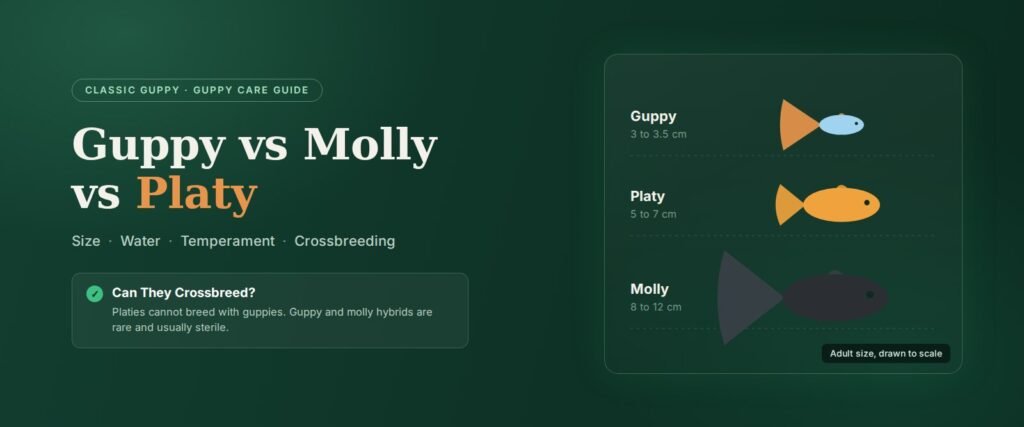
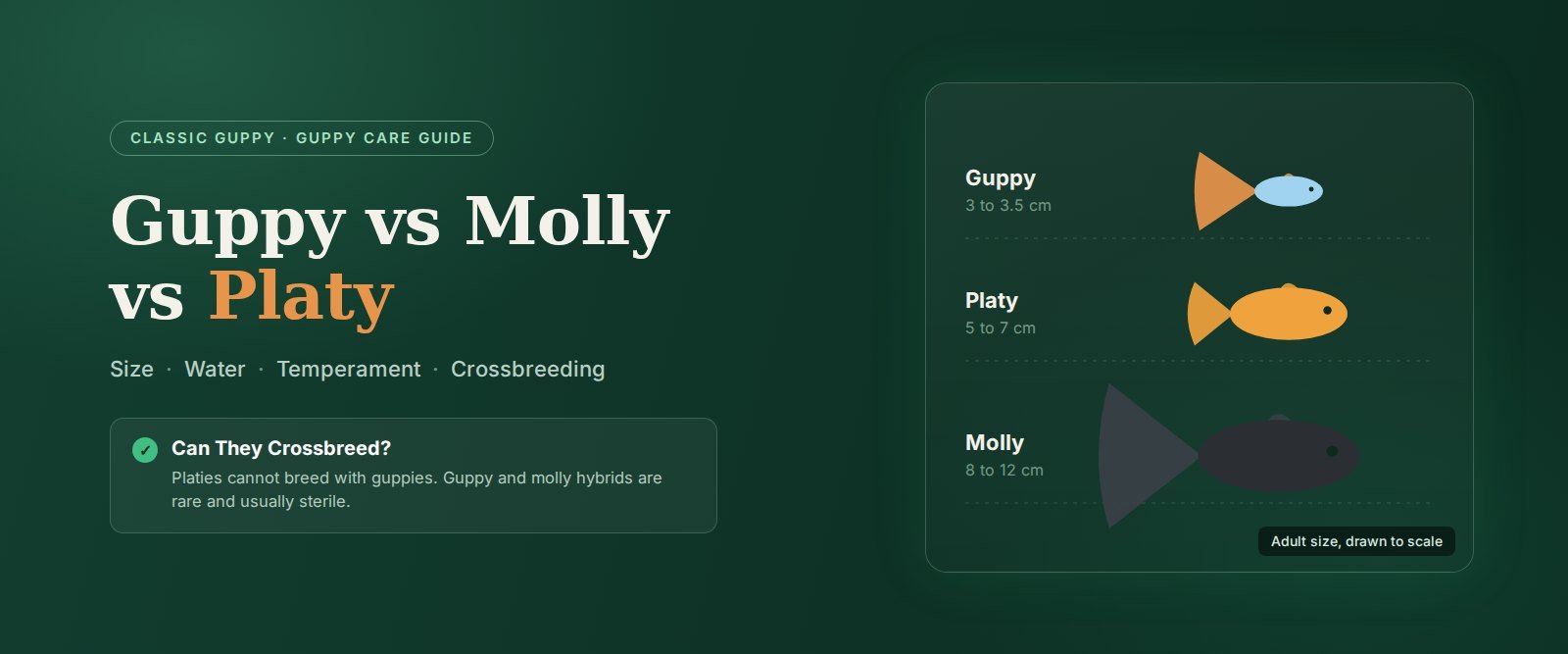
- Guppy: the smallest and most colourful of the three. Males stay around 3 to 3.5 cm, with large decorative tails. Best for small tanks and for people who want to breed for colour.
- Platy: stocky, calm and short finned, around 5 to 7 cm. Handles slightly cooler water than the other two and is the easiest to keep alive.
- Molly: the biggest, 8 to 12 cm, with a heavy appetite and a heavy bioload. Needs a larger tank and does best in hard water.
- Can they crossbreed? Platies cannot breed with guppies at all. Guppy and molly hybrids have been recorded but are rare and usually weak. In normal tanks you will not see it happen.
Three Cousins, Two Families
Guppies and mollies both belong to the genus Poecilia. The guppy is Poecilia reticulata, and the mollies sold in shops are mostly descended from Poecilia sphenops, Poecilia latipinna and Poecilia velifera, often crossed together over decades of commercial breeding. That shared genus is why the crossbreeding question is even worth asking.
Platies are a different branch. They belong to the genus Xiphophorus, the same group as swordtails. The common platy is Xiphophorus maculatus, and the variatus platy is Xiphophorus variatus. So in the guppy vs molly vs platy comparison, the platy is the true outsider. Being in a separate genus matters more than anything else on this page when it comes to breeding, because it puts a hard genetic wall between platies and guppies.
Guppy vs Molly vs Platy: Side by Side
| Trait | Guppy | Platy | Molly |
|---|---|---|---|
| Adult size | Male 3 to 3.5 cm, female 4 to 6 cm | 5 to 7 cm | 8 to 12 cm, sailfins larger |
| Temperature | 24 to 28 C | 20 to 26 C | 25 to 28 C |
| Water | Hard, pH 7.0 to 8.0 | Hard, pH 7.0 to 8.0 | Hard, pH 7.5 to 8.5 |
| Minimum tank | 1 ft for a pair | 2 ft for a group | 2.5 to 3 ft for a group |
| Gestation | About 21 to 30 days | About 24 to 30 days | About 28 to 40 days |
| Fins | Long, showy tails in males | Short and rounded | Medium, tall dorsal in sailfins |
| Diet | Omnivore, small food | Omnivore, grazes algae | Omnivore, needs plenty of plant matter |
| Bioload | Low | Medium | High |
The biggest gap in any guppy vs molly vs platy table is size, and it drives almost every other difference. The numbers above are typical ranges, not hard limits. A well fed female molly kept in warm water can easily cross 12 cm, and fancy guppy females from good lines often reach 5 to 6 cm.
Size and Tank Space
This is where most mismatches start. A pair of guppies lives comfortably in a 1 ft tank with a sponge filter. Put a pair of mollies in the same space and within a few months the water quality starts slipping, because a molly eats and produces waste several times faster than a guppy does. Platies sit in between.
If you are planning a mixed tank, size it for the largest fish. Our guppy stocking guide works well for guppies on their own, but once mollies are in the plan, think in terms of a 2.5 or 3 ft tank and stronger filtration.
Water and Temperature
All three come from hard, mineral rich water, and all three do poorly in very soft water. Mollies are the most sensitive to this. In soft or acidic water they often develop the shimmies, a slow side to side swaying on the spot that usually means the fish is stressed and struggling with its water chemistry. Mollies also tolerate a little salt better than most freshwater fish, which is why some keepers add aquarium salt for them. Guppies handle the same mineral rich water well, so the two are a reasonable match on chemistry.
Platies are the odd one out on temperature. They are comfortable at 22 to 24 C, which suits rooms without a heater in a Pune winter. Guppies and mollies prefer it warmer. A shared tank at 25 to 26 C keeps everyone within range. If your room drops below 22 C in December, read our guide on whether guppies need a heater before mixing species.
For the full set of numbers, including GH and KH, see our guppy water parameters guide.
Temperament in a Shared Tank
Guppies and platies are about as peaceful as aquarium fish get. Male guppies chase females constantly, but they rarely harm anything else.
Mollies are mostly peaceful too, but they are big, fast and food focused. A large male molly can be pushy at feeding time and some individuals will pick at the long tails of fancy male guppies. If you keep show quality guppies with dumbo ears or long ribbon fins, a mixed tank with mollies carries a real risk of torn fins. Platies, with their short fins and slower pace, are the safer companion for fancy guppies.
The fin question is also why these three make better company for each other than with fin nippers like tiger barbs. Our full list of guppy tank mates covers the other safe options.
Breeding Differences
All three are livebearers, and all three will fill a tank with fry if you let them. Females of all three can store sperm and drop several batches after a single mating, so a female bought from a mixed shop tank may already be carrying fry.
Guppy batches are usually 20 to 60 fry. Platies drop similar numbers. Mollies can drop larger batches, and the fry are noticeably bigger at birth, which helps them survive in a community tank. Adults of all three species will eat fry, so floating plants or a separate fry tank make a big difference. If you are new to this, our guide to guppy breeding time explains how to time a birth.
Can Guppies, Mollies and Platies Crossbreed?
This is the question most people actually come for, so here is the plain answer for each pairing.
Guppy and Platy
No. They belong to different genera, Poecilia and Xiphophorus, and they do not produce viable fry together. A male guppy may still try to mate with a female platy, because male guppies try to mate with almost anything, but nothing comes of it.
Guppy and Molly
Rarely, and usually with poor results. Because they share a genus, guppy and molly hybrids have been documented, and fish writer Neale Monks notes in Practical Fishkeeping that they turn up far less often than you would expect in shared tanks. When it happens, it is usually a male guppy with a female molly, because of the size difference. The fry that survive tend to be plain looking, and they are generally reported to be weak and infertile. In a normal tank where both species have their own partners, it almost never happens.
Platy and Swordtail
Yes, freely. Platies and swordtails are both Xiphophorus, and they hybridise easily with fertile offspring. Many of the platies and swordtails sold in shops today already carry genes from both.
Guppy and Endler
Yes, and this is the one guppy breeders really need to watch. Endlers cross with guppies easily and the hybrids are fully fertile, which is why so many fish sold as endlers are actually mixed. Our endler vs guppy guide explains how to tell them apart.
Guppy vs Molly vs Platy: Which Should You Choose?
- Choose guppies if you have a small tank, want strong colours and fins, or want to breed a strain and watch it improve over generations.
- Choose platies if you want the hardiest fish possible, have a cooler room, or want a calm partner for fancy guppies.
- Choose mollies if you have a 3 ft tank or larger, hard water, and want a bigger fish with a lot of personality.
If you keep a guppy strain for breeding, keep it in its own tank. Mixing species in a display tank is fine. Mixing them in the tank you breed from makes it harder to manage fry, and with endlers it can quietly ruin a line.
Frequently Asked Questions
Can guppies and mollies live together?
Yes. They share similar water needs and are generally peaceful together. Give them a larger tank sized for the mollies and watch that the mollies do not pick at long guppy tails.
Can guppies and platies live together?
Yes, and this is one of the easiest pairings in the hobby. Keep the tank at 24 to 26 C so both are comfortable.
Will a male guppy mate with a female platy?
He may try, but no fry will result. Guppies and platies are from different genera and cannot produce offspring together.
Are mollies harder to keep than guppies?
A little. Mollies need more space, harder water and more frequent water changes because of their heavier bioload. In the right setup they are just as hardy.
Which livebearer is best for a beginner?
Platies are the most forgiving, followed closely by guppies. Mollies are easy too, but only once you have the tank size and water hardness right.
Do mollies eat guppy fry?
Yes. Mollies, platies and adult guppies will all eat fry. Dense plants or a separate fry tank are the only reliable protection.
The Short Version
The guppy vs molly vs platy choice mostly comes down to tank size and water. Guppies, platies and mollies make good neighbours as long as the tank is sized for the biggest fish and the water is hard enough for all three. Platies cannot breed with guppies, guppy and molly hybrids are rare and usually sterile, and the cross that really matters for guppy keepers is the endler. Pick the fish that fits your tank rather than the one that looks best in the shop.
If guppies are your choice, browse our home bred strains in the Classic Guppy shop, all shipped across India with live arrival guaranteed, and read our guppy care guide before they arrive.